

April and May are the dog days of summer on the Indian plains. A heat wave grips much of India as I leave my mountain respite in Himachal Pradesh for the flats of Punjab. It takes five hours to cover the 130 miles to Amritsar. Luckily I’m in a shared taxi with air conditioning – luxuries to which I’ve grown unaccustomed.
It’s after 10 p.m. when we reach the guesthouse and there’s the usual rigmarole. This time the rooms we booked aren’t the rooms we get. It’s not shocking – one learns to temper their expectations when traveling in India.
We pluck dinner from nearby food carts and walk for the Golden Temple. Minaret shaped towers are brightly lit against the night sky and hundreds of pilgrims lay sprawled in various states of slumber across huge expanses of white marble.
My dress isn’t modest enough to enter, so we just wander around outside. Through one of the grand entryways, I’m able to catch a glimpse of the golden shrine at the center. It sits on an island, and in the gaze of a thousand spotlights, shines like a star.
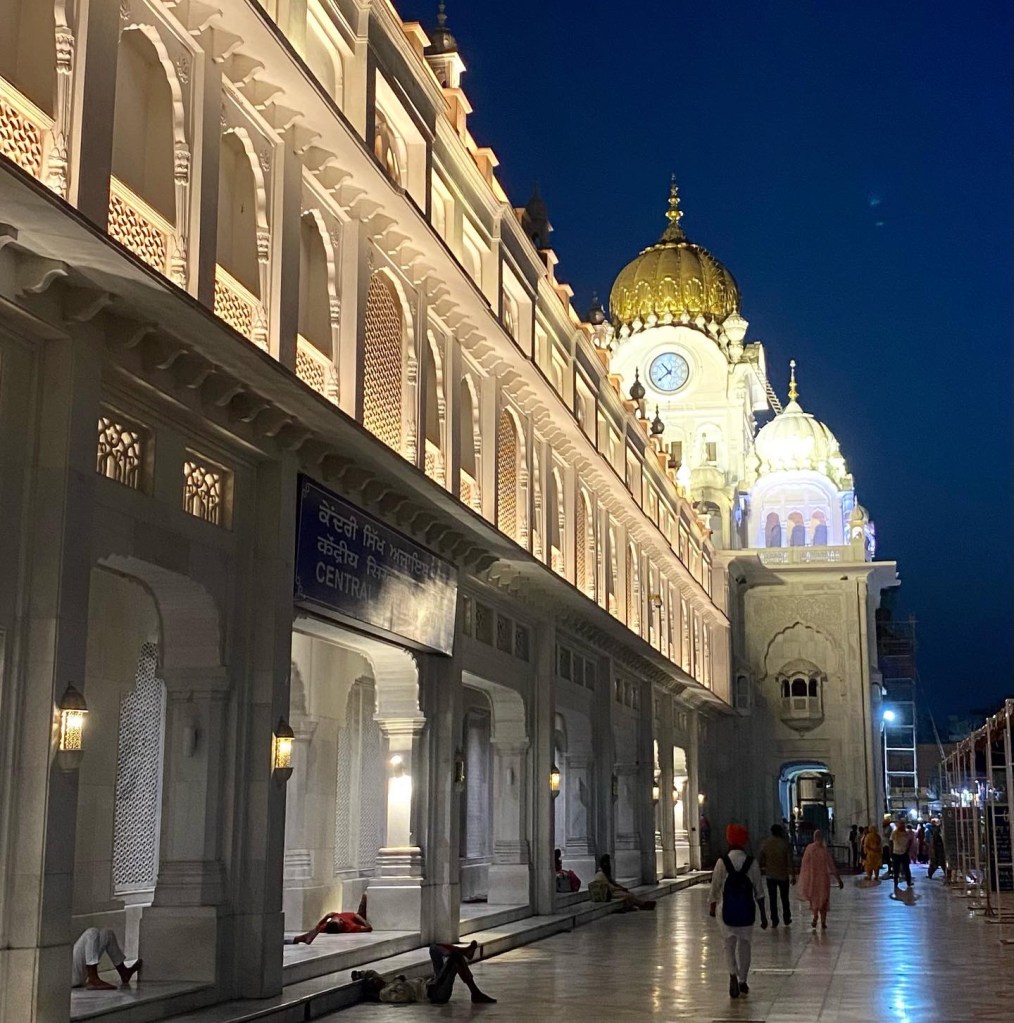
Amritsar is the second largest city in the Indian state of Punjab and the spiritual center of the Sikh religion. The Hermandir Sahib, or “abode of God” is a sprawling temple complex and draws up to 150,000 worshipers on any given day.
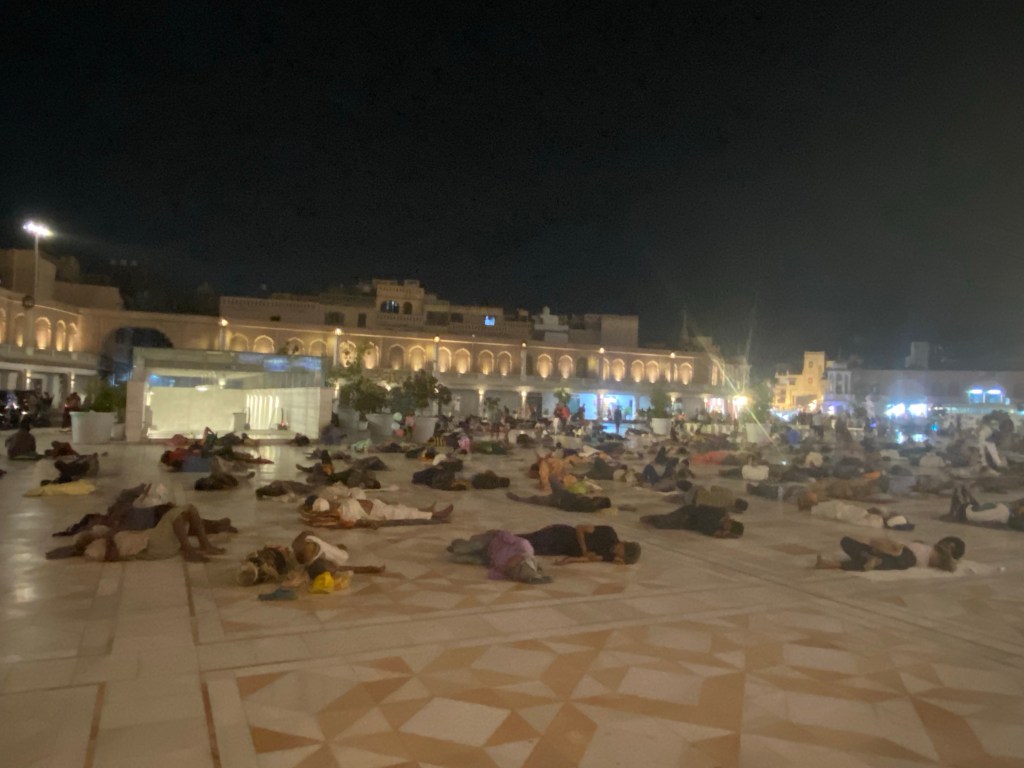
The Golden Temple is the most significant shrine in Sikhism. The shrine itself is just a part of the much larger gurudwara, literally “doorway to the Guru”, or place of worship for Sikhs. It was founded in 16th century and houses countless shrines, colonnades, offices, plazas, and museums.
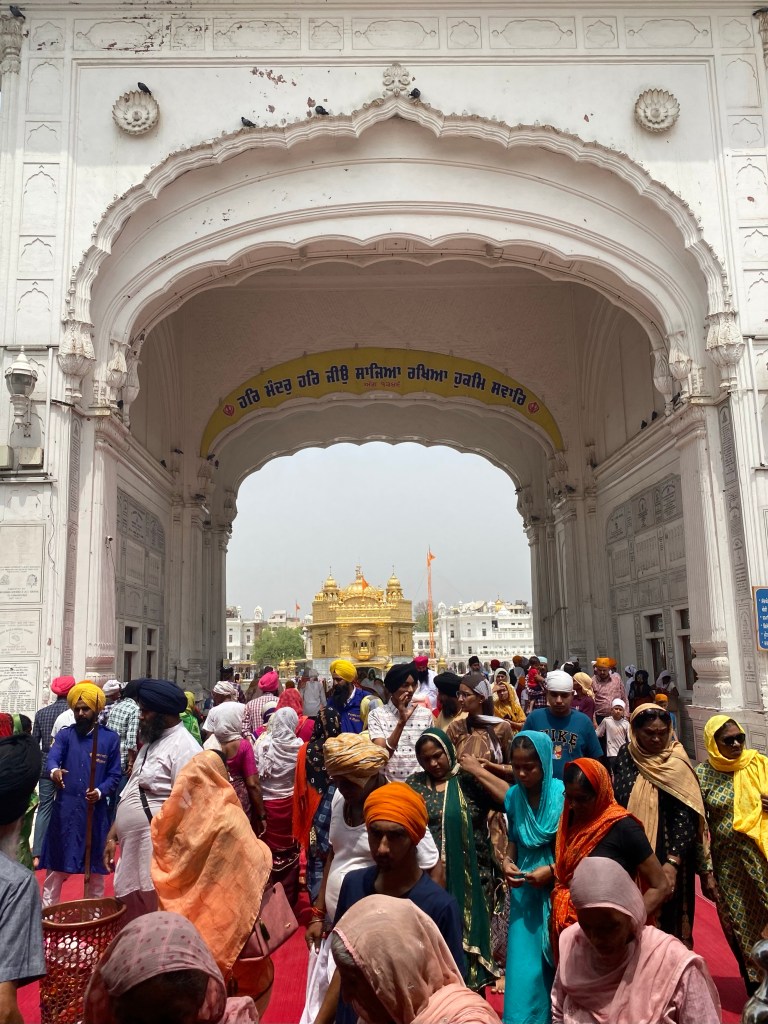
The Hermandir Sahib is an open house of worship. Everyone is welcome, regardless of religion, caste or creed. The entrance gates are positioned in all four directions as a show of acceptance and openness to all people. Most religious sites I’ve visited are elevated, but the Golden Temple actually sits below ground level. It serves as a symbol of the need to remain humble.
To enter, one must cover the head, shoulders, and knees. Shoes must be left outside and there’s a shallow moat in which to clean your feet. After passing through a giant archway and descending a set of marble stairs, the Golden Temple glitters from the center of a sacred lake.
In ancient times this was a small lake in a quiet forest, where wandering mendicants, including the Buddha, came to contemplate. The waters are said to have restorative and karma purifying powers. This sarovar, or holy tank, is filled with amrit, or holy water, which is how the city of Amritsar got its name.

The Sikhs
Across the gurudwara, men sit in shrines, leaning over copies of the Guru Granth Sahib – the sacred scripture of the Sikh faith. It’s a collection of devotional poems, prayers, and hymns composed by the ten Sikh gurus and various Muslim and Hindu saints. Sikhs see the Granth as the guide and guru that will lead to spiritual enlightenment and ultimate realization of one’s own divine nature.
Sikhs believe in one creator that is inseparable from creation; all aspects of reality are manifestations of the One. The way to experience God is through creation, by inwardly meditating on the all-pervading nature of divinity. Sikhs believe that the soul transmigrates through countless lifetimes in a cycle of birth and death. Teachings center on the ego, its effects on the soul, and enlightenment as liberation from the ego.
The Sikhs have a long history of fierce independence. Centuries ago, they faced off with the marauding armies of Mughal and Afghan invaders. In more recent times, clashes with the Indian government led to a direct assault on the Hermandir Sahib. Like other ethno-religious minorities in India, there is a movement within the community for the creation of an independent state.
Sikhs consider themselves soldier-saints, in defense of the good and the weak. They’ve historically sided with underdogs and one of their core tenets is “fear none, frighten none.”

Sikh men cut an imposing appearance. Long hair is wrapped atop the head and tucked under a trademark turban. They wear shiny iron bangles at the wrist and a ceremonial sword sheathed over flowing robes. Many still wear the traditional juttis, richly embroidered slippers that curl up at the toe.
Initiates must wear the Five Ks at all times. These outward symbols represent their devotion and submission to God.
• Kesh, or uncut hair. Hair is seen as a gift from God and keeping it uncut indicates modesty. It’s a symbol of holiness and strength. Men wear it tied atop their heads under a turban.
• The Khanga is a wooden comb that’s worn in the up-tied hair. It symbolizes a clean body and mind. Care for the body is essential on the path to enlightenment.
• A Kara is a steel bracelet. It’s made of steel, rather than gold or silver, because it’s not an ornament. It denotes restraint and a direct link to the guru.
• Kachera are special underwear that are cut above the knee, which is particularly useful for combat or horseback riding. They represent self control and a willingness to be ready for battle at a moment’s notice.
• The Kirpan is the ceremonial sword. As defenders of the weak, the sword is a metaphor for the struggle against injustice. Kirpans range in size from a few inches to a few feet and are worn in scabbards.
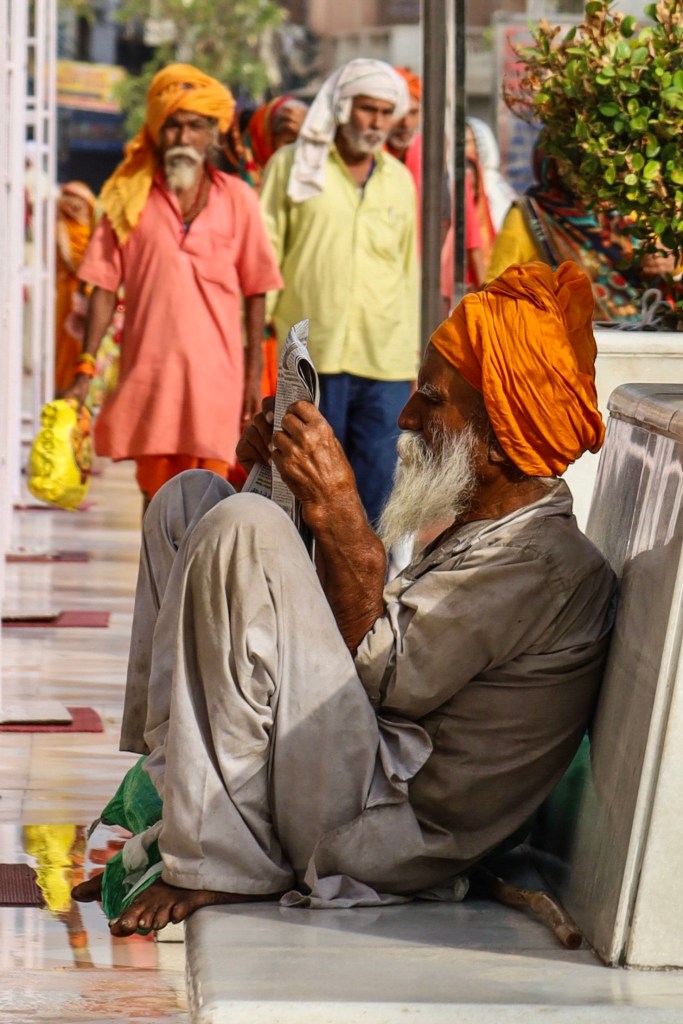
It’s best to arrive at the temple in the relative cool of the morning. While it would be a fertile ground for any photographer, cameras are forbidden. Luckily, in the age of the selfie, they’re mostly tolerant of a quick click with your phone.
There are cloak rooms and shoe checks, and bins of cloth to cover your head should you leave home without your turban. Aside from the gold of the temple, the complex is built entirely of white marble. It gleams so bright in the Punjabi sun that you have to shield your eyes.

You can access the Golden Temple through a slow moving line that passes on a causeway over the sarovar. It feels something like a gilded cattle chute, but the people watching is excellent. This is like the Vatican for the Sikhs and we’re about to stroll through the papal boudoir.
The excitement is palpable.

The line bottlenecks at the entrance to the temple and a crush of humanity spills over the threshold. In the inner sanctum, musicians play traditional ragas on tablas and hand drums. The singers’ vocal inflections are more reminiscent of Arabia than India. The music is piped over loud speakers across the complex, and broadcast across the city. Under a giant tasseled canopy of precious stones, an elder reads from a giant copy of the Guru Granth.

Intricate inlays of animals and colorful wildflowers decorate the marble walls and the whole thing is replete with gold. Pilgrims are quickly shuffled through by stern attendants – volunteers relishing a new-found sense of authority.
The crowds bow to the celebrants and toss rupee notes over a brass rail. They cry out to the holy of holies and try to loiter as long as possible before being moved along. One can’t help but be moved at the sanctity of this place and the devotion of the people.

Past the inner sanctum, a back stairway leads to an upper level. The majority of the crowd are unaware of it, so it’s a bit quieter. The jeweled hallway is the perfect place to sit in contemplation or watch the procession below.

The Langar
One of the coolest features of gurudwara is the langar. A langar is a community kitchen that serves free meals to all. Everyone, regardless of class or rank, sits on the floor and eats as equals. Every gurudwara has a langar – it’s tradition that dates back to the founding gurus.
The langar at the Golden Temple is the largest free kitchen in the world and it’s run by an all-volunteer staff. On a normal day, between 50,000 and 60,000 meals are served; on weekends and holidays, it’s upwards of 100,000!

The vegetarian fare is simple but good. Staples include roti (flatbread), rice, beans, daal (lentils), and kheer – a rice pudding that the Granth Sahib praises as having the “divine flavor of immortal ambrosia”. It does.
People sit side by side in long rows in one of two dining halls, where up to 5000 people can eat at a time.

Volunteers move down the rows, dishing food from huge buckets until you’ve had your fill. Others emerge with brooms and mops to clean the area before a new group cycles through. Hundreds of people work to keep the kitchen humming 24 hours per day. It runs like clockwork.
Outside, people peel small mountains of garlic and trim the literal tons of vegetables. Inside, they labor in the steam. Men swirl enormous cauldrons with paddles the size of canoe oars. Some volunteers stay a few hours, others a few days. All of them serve happily, upholding Sewa, or selfless service, one of the three tenets of Sikhism.
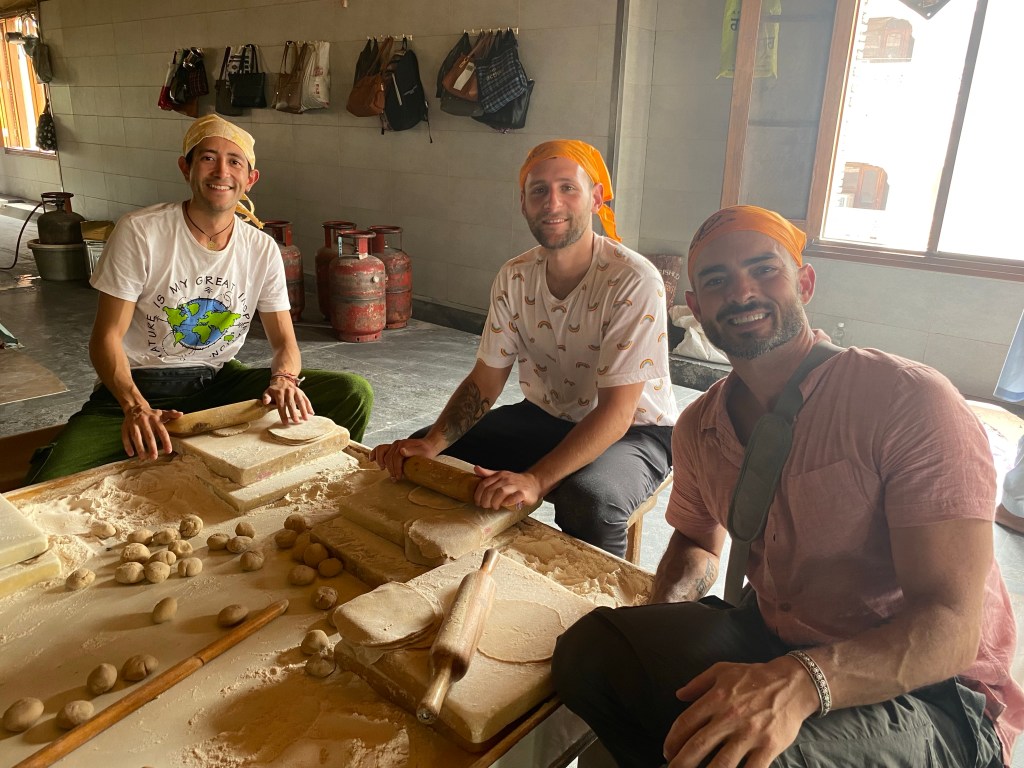
I try my hand at the rotis. The women around me work mechanistically, forming little dough balls and rolling them into perfect discs. My efforts are slower and clumsier. On holidays, they have a machine that can make 25,000 rotis per hour!
Around Town
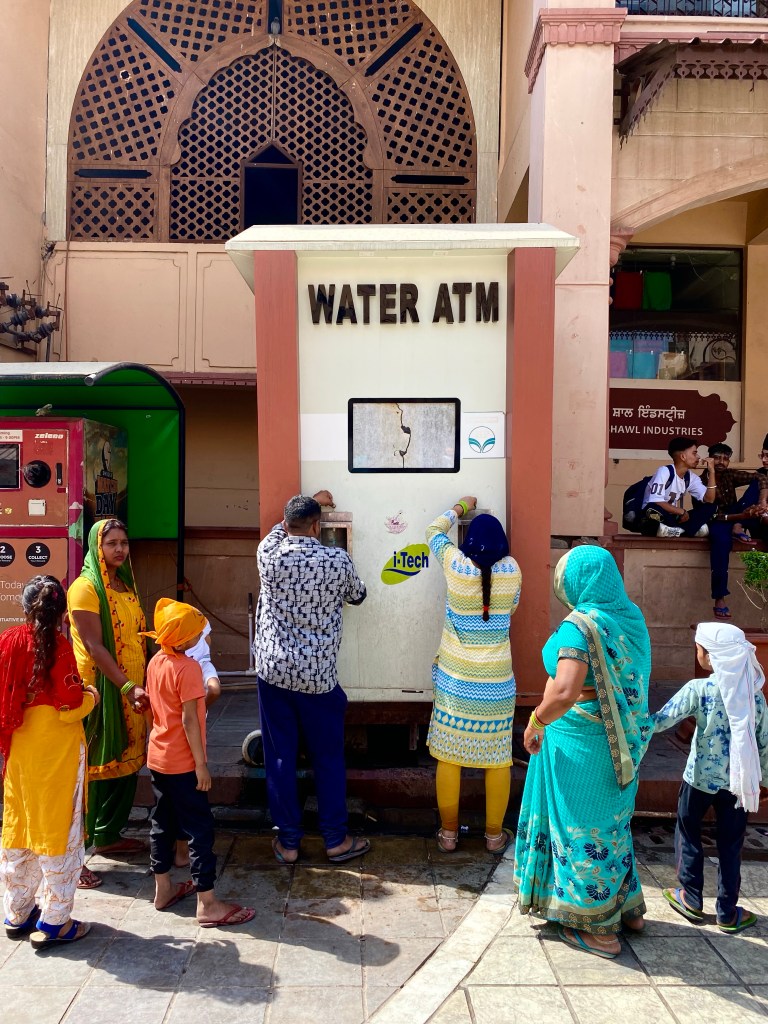
The Sikh Museum
The mornings and the evenings here are bearable, but midday is sweltering. A mild breeze feels like standing before a hair dryer. The Sikh Museum is a great place to escape and learn about the history and the faith. The museum is located under the giant plaza outside the main entrance to the gurudwara.
In a series of (air conditioned) viewing rooms, films outline the history of Sikhs, their religious belief system, and the evolution of the Golden temple. It’s an incredible story of valiant battles, victory over oppression, and martyred men who chose the grave to compromising their convictions.

The Partition Museum
The Partition Museum is also worth a visit. The partition of India is a defining event for the region. When the British relinquished colonial control of the subcontinent, the struggle between the Hindu majority and the Muslim minority led to the division of India and the creation of Pakistan.
It resulted in the largest migration in human history and a series of tragedies that reverberate to this day. The museum is an in depth look at the lead-up and aftermath of the decision to divide a people.

Jallianwala Bagh
Jallianwala Bagh is a memorial garden to the victims of a historic massacre at the hands of the British. The little oasis is only a short walk from the Golden Temple. In 1919, a peaceful public protest turned deadly when a British general ordered his troops to open fire on the crowd. Casualty estimates vary wildly, but between 400 and 1500 are said to have perished here.
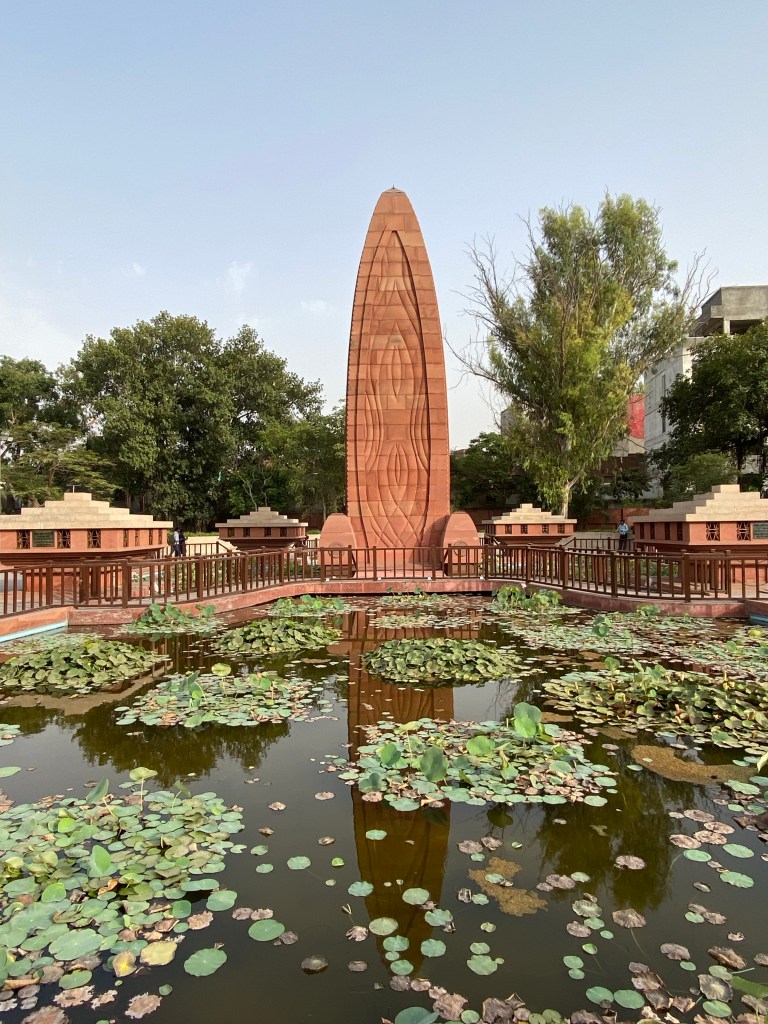
Today, the garden stands as a somber reminder. Its walls are still pockmarked with bullet holes you can look down into the well where 120 people drowned while trying to escape the bullets.
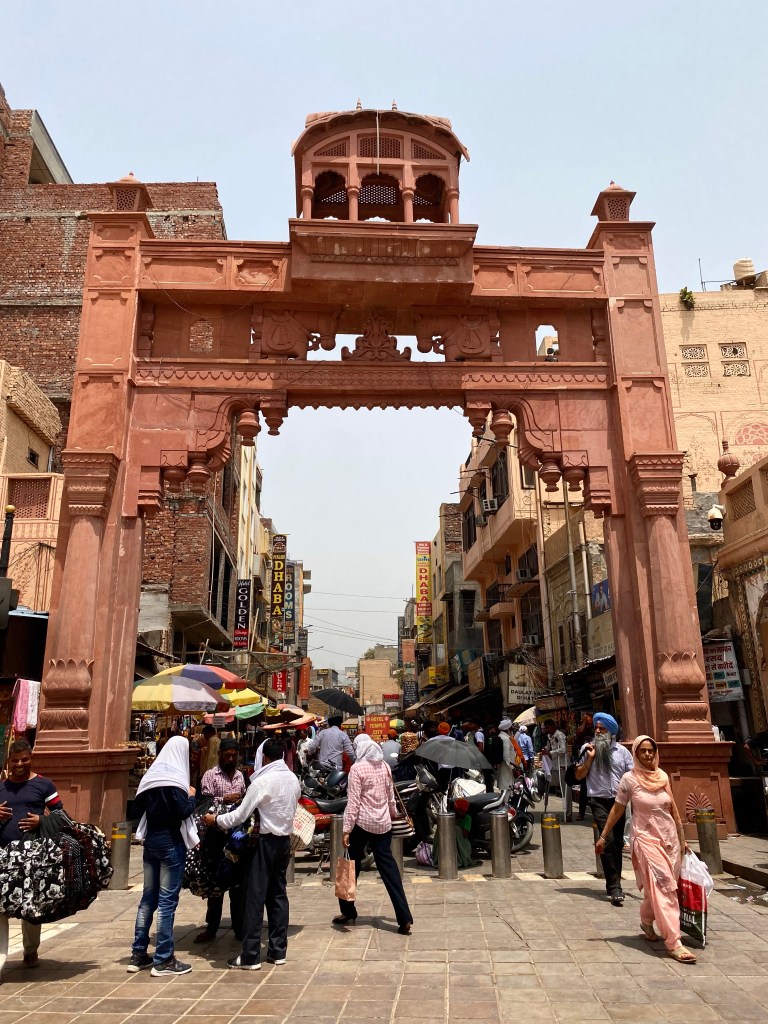
The streets of Amritsar are lively. Just north of the Golden Temple, street hawkers cater to crowds of pilgrims in a large market that’s blocked from motor traffic. An ice cold cold lassi and a walk among the shaded stalls is the perfect balm for the afternoon heat.
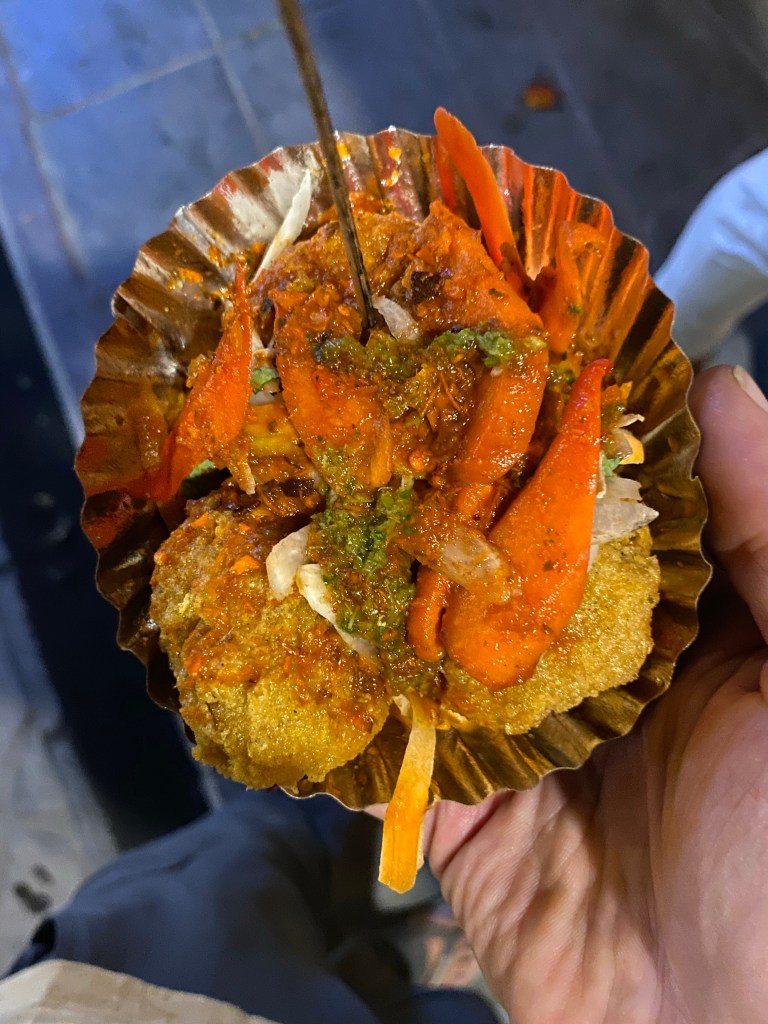
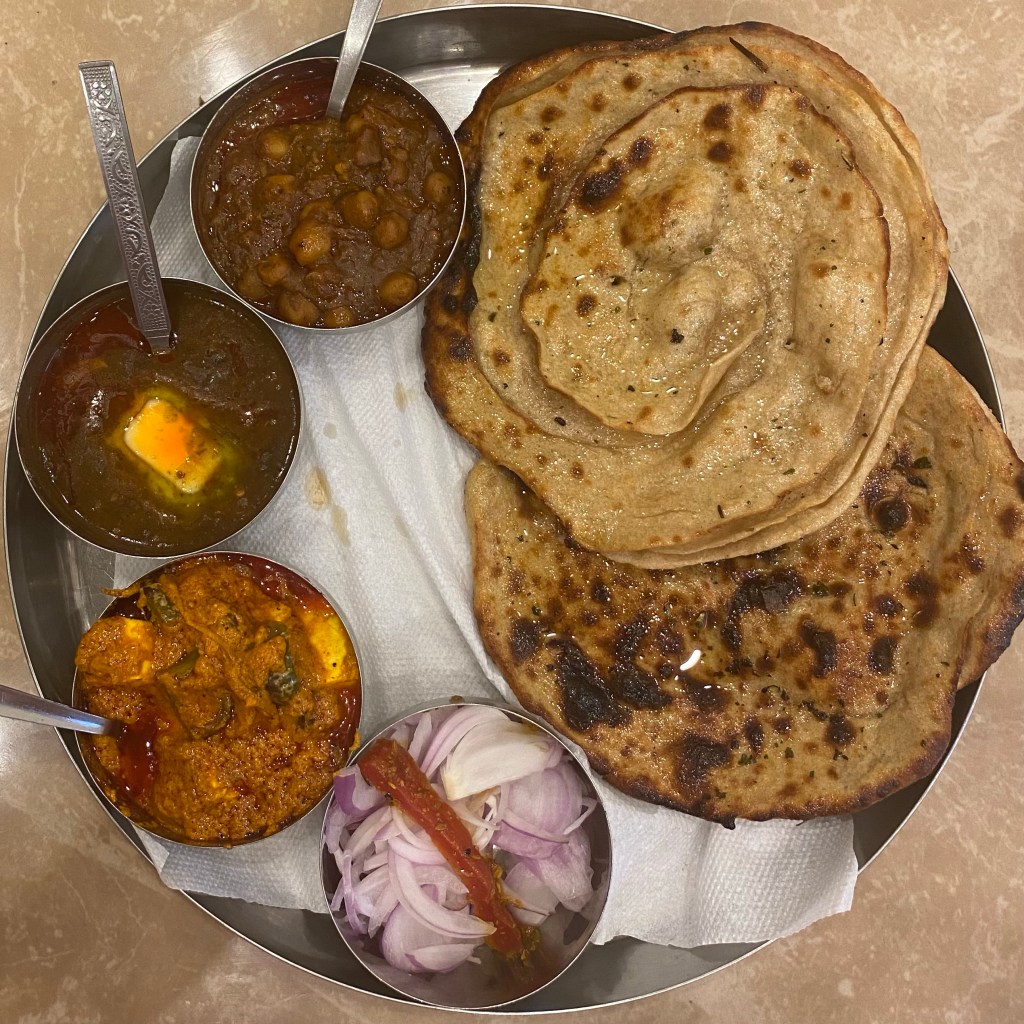
Punjabi dabhas are famous across India for good, cheap food that sticks to your ribs. Everything is cooked in butter, spread with butter, and topped with butter. It’s tasty, if a little heavy for the weather.
The street food scene in Amritsar is on point. I grab whatever looks good, but it’s all about the the Amritsari kulcha. It’s a stuffed flatbread cooked in a tandoori oven. After it comes out, all brown and crisp and chewy, it’s finished with clarified butter.
The Wagah Border
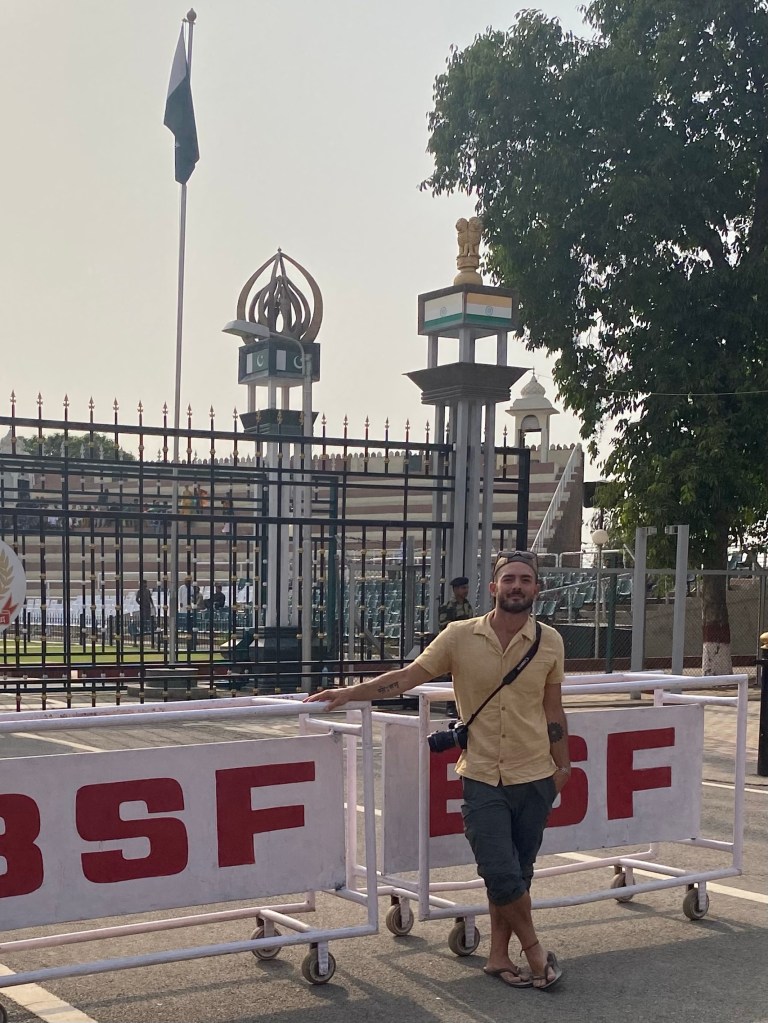
The India-Pakistan border is just 19 miles west of Amritsar. Since the 1947 partition, the two countries have had an adversarial relationship punctuated by armed flare ups over disputed borders.

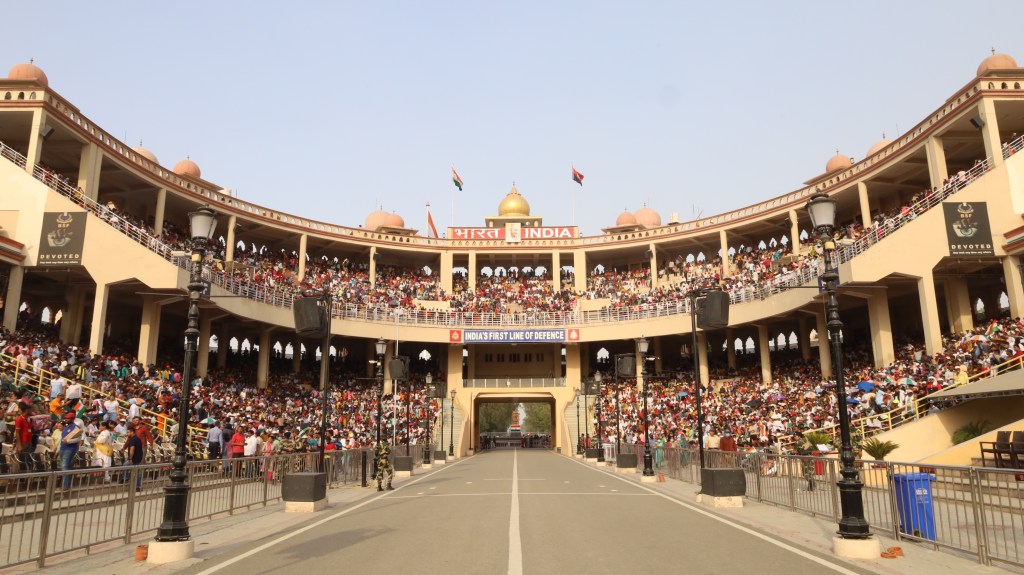
The Wagah Border is a military outpost on the border between Amritsar, on the Indian side, and Lahore, on Pakistani side. Every evening, soldiers from both sides face off in a flag lowering ceremony full of pomp, pageantry, and lots of bluster.
From the main bazaar in Amritsar, it’s easy to find a shared ride to the border. It takes an hour by tuk tuk to reach Attar, a village about a kilometer out. The security is tight. You’re allowed a camera and a phone, but that’s about it – even my wallet is questioned. Cell networks are jammed, so your phone is really only useful as a camera. Luckily, there are places to check your extra belongings for a few rupees.
While the border sees little actual traffic, thousands of people gather at sunset to watch the “Beating Retreat Ceremony”. Performed since 1959, the 30 minute ceremony includes the lowering of the flags and the closing of the international gates for the night.
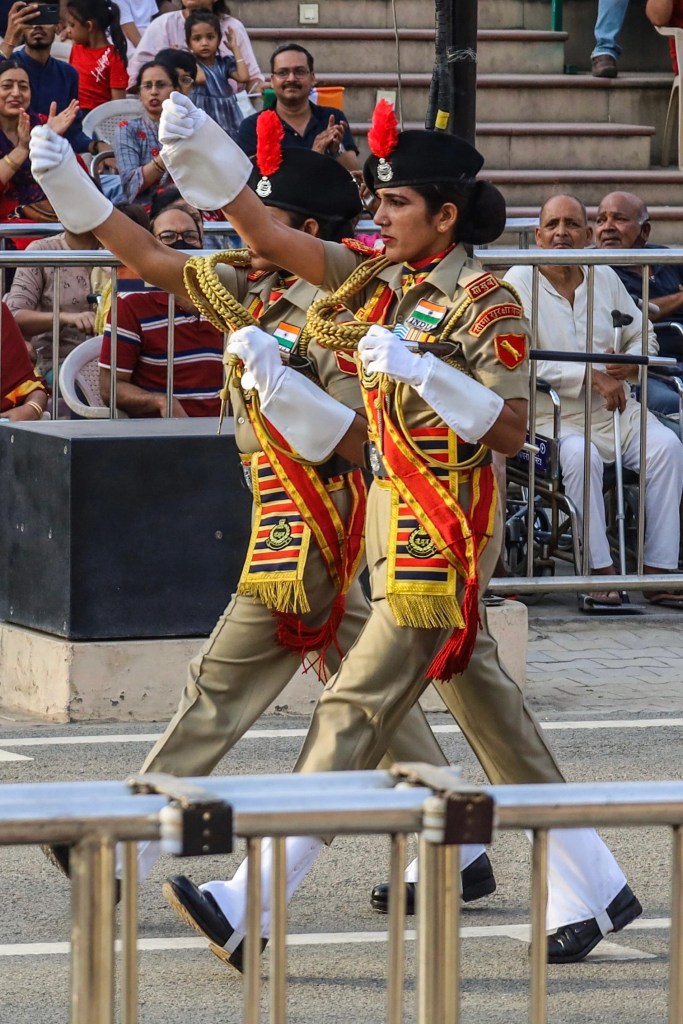
More than anything, it’s a display of national pride. There’s a large semicircular stadium on the Indian side for the flag-waving throngs, while the bleachers on the Pakistani side are markedly less crowded. (Foreigners get to sit in a VIP section towards the front and closest to the border.)
There is chanting and taunting from each side, and after the national anthems are played, the whole stadium erupts into a Bollywood-style dance party.
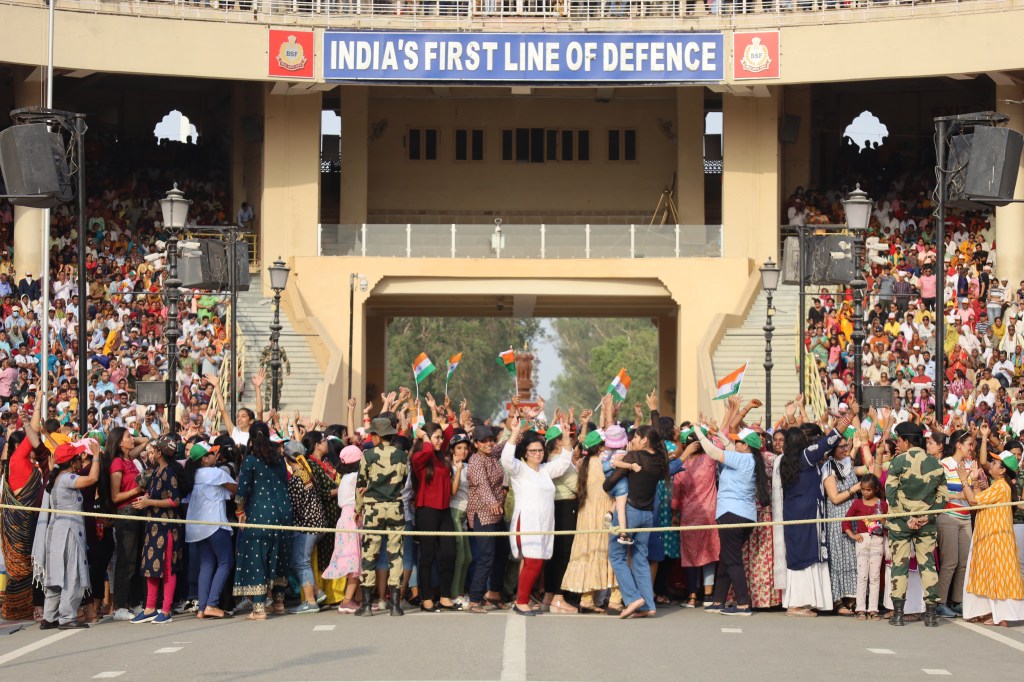
When the dancers clear, a military procession begins. A senior officer gets the crowds going with gesticulating hands and loud barks. Officers march in goose step towards the each other, stomping and kicking as they near the border. It’s all very well choreographed and theatrical that the movements of soldiers on either side actually mirror each other.

The ceremony culminates in the lowering and folding of the flags. Soldiers stand at attention, chests puffed, facing their counterparts. The flags are lowered and folded simultaneously. Two ranking officers share a brisk handshake across the official border line and turn about face as the gates clang shut for the night.

The whole thing is quite a spectacle. While it’s definitely the touristic thing to do when in Amritsar, I thoroughly enjoyed it.
I bulk of my time in Amritsar is centered around the Hermandir Sahib. It’s a nucleus of spirituality and devotion, and such places are always very special.
Any place where a great number of people come to express and experience religious energy, offer devotion, and commune with their sense of the divine has a sublime power.
Meditating in the upper reaches of the Golden Temple and circling it under the stars amid a crowd of thousands, lying in the shaded porticos and bathing in the holy water – the power here is tangible.
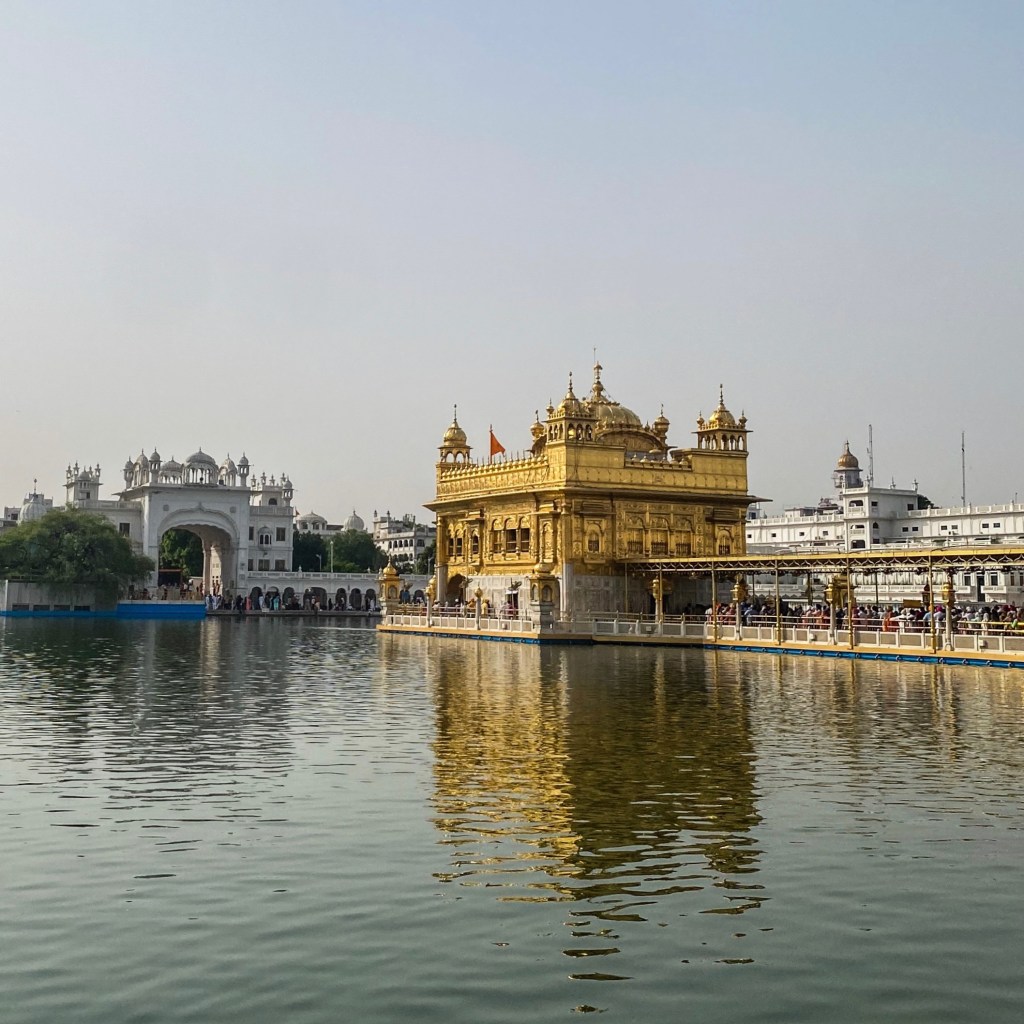
‘Waheguru’ is the Sikh mantra.
You can’t walk more than a few steps in Amritsar without hearing it. It’s used in greetings and goodbyes. I think about it with an exclamation point.
Most often, it’s just shouted as a sort of cheer, an outward expression not directed at anyone in particular. It’s the Sikh version of ‘hallelujah’ or ‘Allahu Akbar’.
Waheguru is the combination of two words: wahe, which is Punjabi for wondrous, and guru, Sanskrit for “remover of darkness”. Taken together, it implies a state of total astonishment at the greatness of God.
Waheguru, indeed.
 Christopher’s Travels
It’s great to read this article, thanks for sharing your experience of visiting Amritsar. I hope, you will explore more places in Amritsar. There are many hidden gems in Amritsar to visit, hope you will do try to explore. But if you need any kind of suggestion then please mail sir. I’m from Amritsar & thank you once again for exploring Amritsar.
Wonderful blog. Everything very well done. I posted my response on that page. The only issue seemed to be with the video of food being served. Mom viewed on her laptop and I viewed at a different time on fire tablet both with the same results. Would not run smoothly. Thanks for sharing this- made me feel as if I had been there…