
The Southwest Monsoon
During the summer, when the air over India grows very hot, it expands and rises. Cool sea air rushes in to take its place, creating a massive air current that reaches south of the equator. The current gathers moisture over the ocean and drops it as rain over the land. As the rain cools the land, the heat is driven farther upward, allowing for even more wet air and creating a huge convection that pushes the monsoon across India.
It starts in early June, off the coast of Kerala in the southwest, and reaches the northern state of Himachal Pradesh a few weeks later. Where I put up in Dharamshala, clouds can hang about on the mountains for days, wrapping everything in gentle mist and a steady rain at dawn might last until supper. The amount of water is staggering.
This is the southwest monsoon. It inundates most of the country, and brings about 70% of India’s annual rainfall. The Himalayas, however, provide a natural bulwark against the front and spare the arid lands to the north. As Himachal hunkers down and life proceeds under cover of umbrella, those who can, escape to the sunny highlands of Ladakh.
The Leh-Manali Highway

The Leh-Manali highway connects Leh, the capital and largest city of Ladakh, with Manali, in northern Himachal Pradesh. It’s a sometimes-paved road over high mountain passes that’s only open about six months of the year. Ladakh is the Land of High Passes: “La” means pass and “Dhak” means multiple.
This highway is legendary. It’s considered one of the most dangerous roads in all of India , which is quite a feat. It passes through windswept valleys and along cliff’s edge, often as a single lane, in an area where a little rainfall triggers landslides.
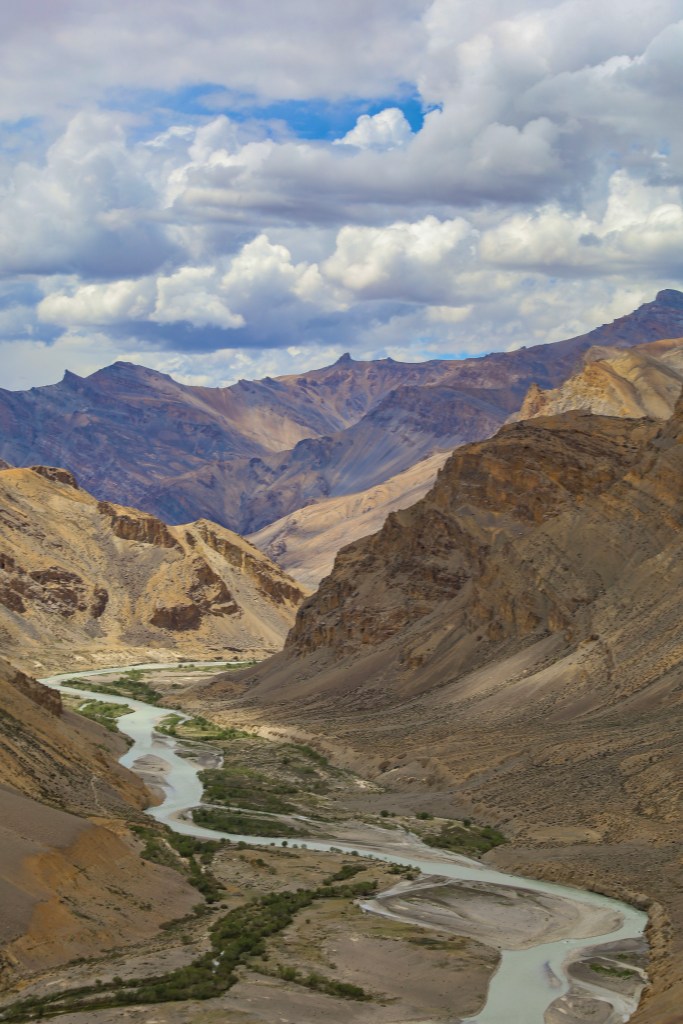
It’s not for the faint of heart (or stomach) and the drivers are fearless. They gamble against oncoming traffic to overtake the lumbering trucks, and double down around blind curves. The stakes are high and the valley floor is littered with the crumpled wrecks of those who wagered everything and lost.
Public buses ply the route over two days, but I’m no masochist. Tempos are passenger vans on steroids that cover the distance in about half the time. And the upgrade is worth every rupee.
I skip my morning coffee to make a 6 a.m. departure, but in true Indian fashion we roll out at 7:30. Uncaffeinated, I fall back to sleep to a cool breeze and pine trees whipping past outside the window.

When I wake a short time later, everything has changed. Gone are the forests, or really any vestige of green, replaced by barren brown rock, jagged peaks, and an enormous sky. The only vegetation is some defiant scrub brush along a stream bed.
It’s the stop that wakes me, when we pull off at the first military checkpoint. Ladakh and Kashmir, one state until 2019, are contentious pieces of real estate. Both China and Pakistan lay claim to areas under Indian control, and in the case of Kashmir, there’s plenty of internal discontent.

Military posts are tucked everywhere, and traveling beyond Leh requires a special permit. Still, the checkpoints are antiquated: a metal hut, a couple of guys with automatic weapons, and a hand operated boom gate. We hand over our passports and stretch our legs while the soldiers record our particulars into a paper logbook.
The road is mix of gravel and shoddy pavement set out over 270 miles. Its placement is relatively unfixed from year to year, moving at the whim of melting snows and the restless geology of the Himalayas. The Tempo’s suspension is long worn, leaving me keenly aware of each bump along the 14-hour journey.

We stop for food in ramshackle towns of corrugated metal, where little shacks sit unsheltered in the emptiness of giant brown plains. We pass goat herders living in yurts and groups men patching the road by hand.
There are no earth movers, steam rollers, or traffic cones out here. Where human labor is cheap, and seemingly expendable, it’s all done by hand. Roadbeds are formed with rocks and shovels, and smoothed with over with tar heated on open fires. The workers live in tarp-covered hovels along the roadside that move with them as the work progresses.
For the most part though, it’s just emptiness: a staggering, dry ocean of open space. It’s more nothing than I have ever seen in my entire life.
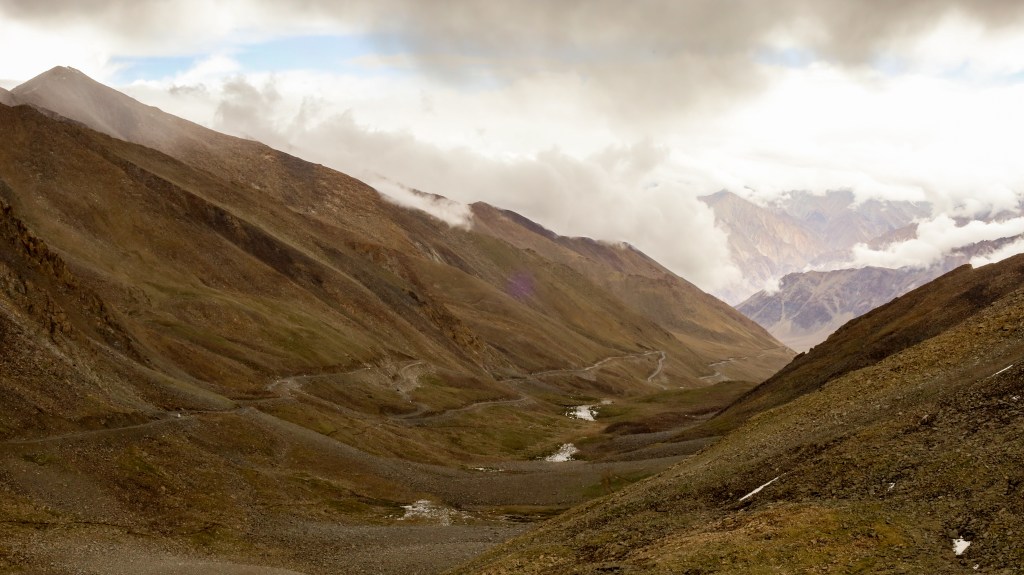
At 17,600 feet, Taglang Pass is the high point of the journey. We reach it late in the afternoon, just as the sun is even with the mountaintops on the horizon. The passing clouds cast enormous slopes in shade and dapple the valley floor like a golden leopard.
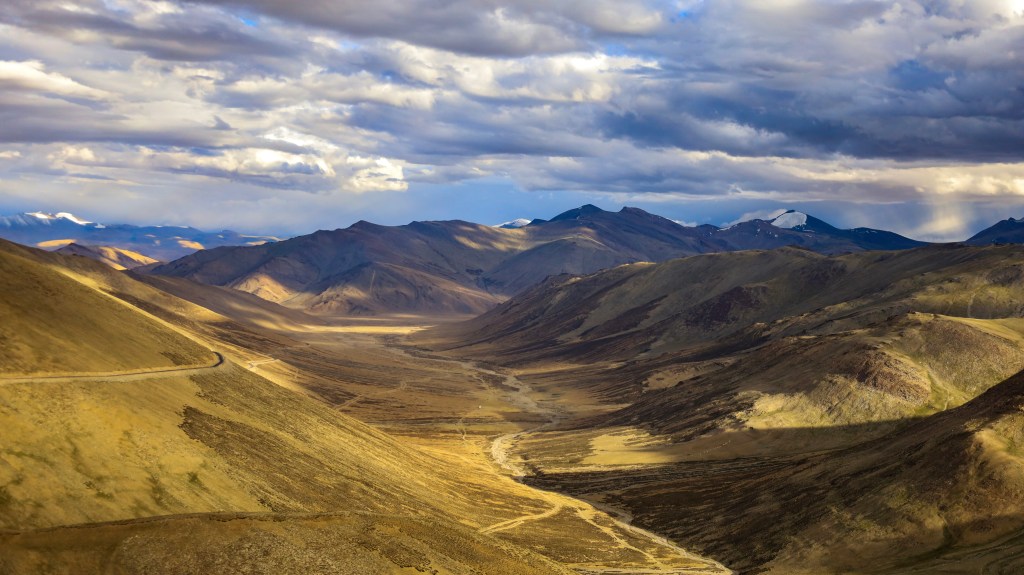
A long series of switchbacks leads into the shadows of the Indus Valley. We pass through little villages, and in the fading light I can make out the silhouettes of Buddhist stupas.
India is a Hindu country by vast majority, but Ladakh is the land of Lord Buddha. Known as “Little Tibet”, the landscape, architecture and large population of Tibetan refugees make it almost impossible to distinguish from the Chinese-occupied territory to the north.

It’s after 9 p.m. when we reach a dark and deserted bus stand in Leh without tuk tuk or taxi in sight. In half a city block, I’ll fend off a dozen of them, but after 14 hours crossing the Himalayas, there’s not a one.
Thankfully, my friends already have a guesthouse arranged and I’m only a mile and a half from a hot shower and a clean bed – albeit uphill.
The Sangha

When the monsoon arrives in Dharamshala, the Dalai Lama retreats to Leh for the season. Every July, my friends come to get a reprieve from the deluge and hear him teach. After my own detour in the Parvati Valley, I join up with them.
A sangha is a spiritual community in the Buddhist tradition. Initially used to describe ordained monks and nuns, it’s expanded to include all practitioners or any group who studies the teachings together.
In Dharamshala, I find such a group. It’s an international set with a core of 15, who range in age and background, but share a desire to study the dharma. Some come for extended periods, while others live in Dharamshala full time. The teachings are given twice daily by a particularly playful Tibetan lama that we call Rinpoche.
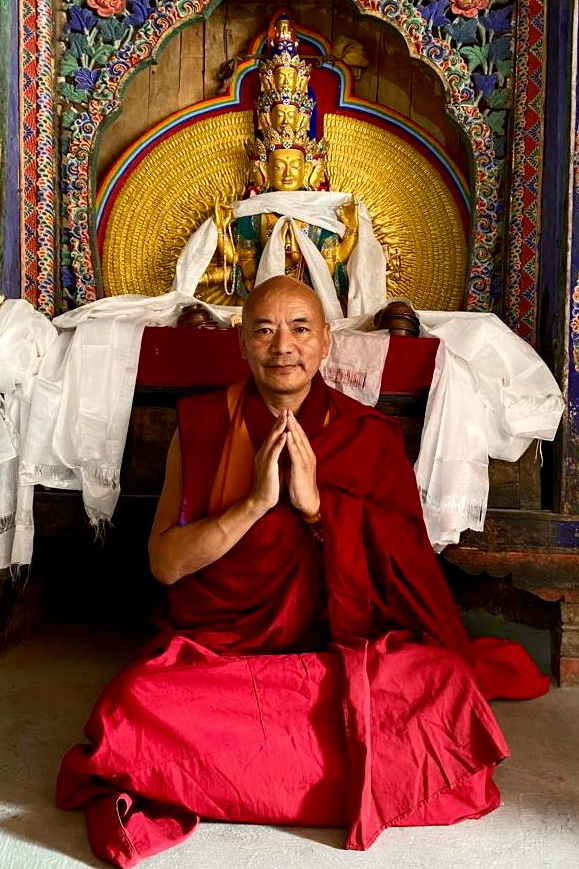
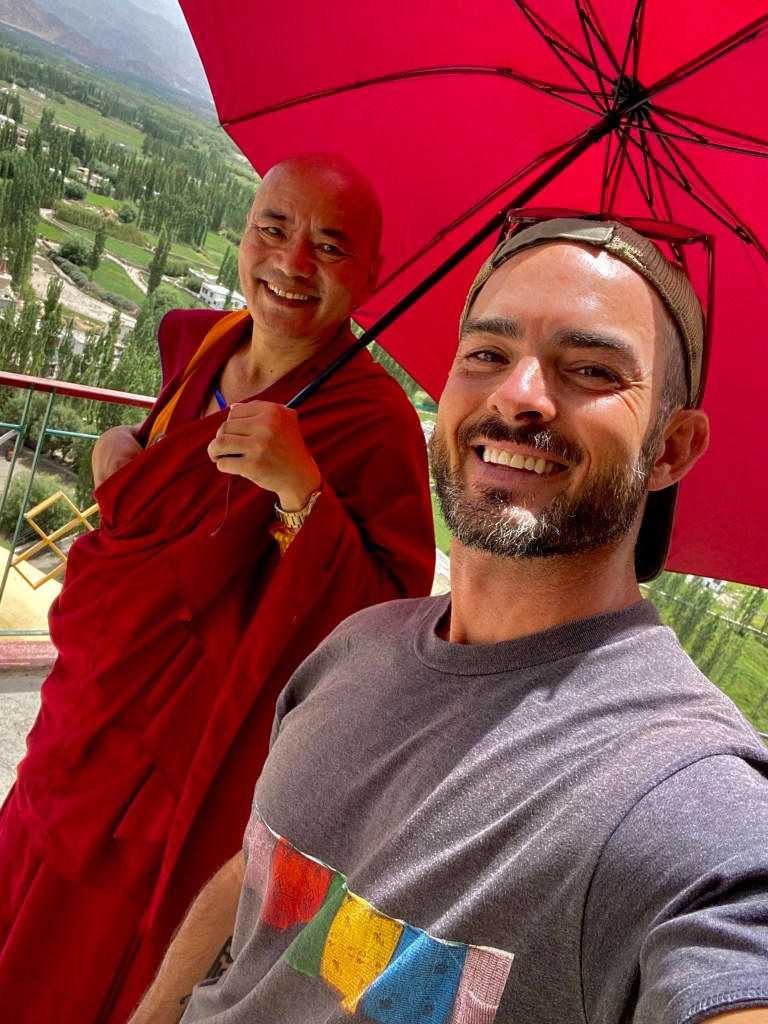
Rinpoche, literally means ‘precious one’, and he’s just that. Geshe Choegyal Lobsang has a gleam in his eye and a near-constant smile. He exudes a childlike joy and is prone to fits of belly laughter.
Whenever the Dalai Lama appears in public, Rinpoche is close at hand. He’s versed on scripture, the nature of the human mind, and higher tantra; a secretive, mystical set of practices reserved for only the most adept.
He also loves to take selfies.
Classes are held in a little apartment just outside of the Dalai Lama Temple. Clutching his mala beads, he always opens by asking if there are any questions – newcomers first. There normally are, and the teachings then unravel over the course of an organic conversation that can last several hours.
Other times, he has a subject in mind. Morning classes tend to follow a curriculum and Fridays are set aside for group meditation. He’s a big proponent of study, always stressing the need to take advantage of this precious human birth.

Rinpoche is said to be a tulku. Tulkus are the reincarnates of dead masters, who, at a very young age, are sought out and brought to monasteries for training and study. He has an encyclopedic knowledge of the Buddhist texts. More importantly, I believe he’s attained some high levels of realization, though such things aren’t discussed.
“This is a rare opportunity,” he likes to explain. “How often will we have this chance?”
Rare indeed.
The series of life events that bring me to this sangha in the mountains of northern India could not possibly be scripted. It required the perfect alignment of circumstances over an entire lifetime (perhaps many of them) to arrive here just now. And it’s true for each one of us.
How unlikely is it that we all arrive here independently, from across the globe, with the time and the resources to dedicate ourselves to the practice, when there’s a willing teacher?
Buddhists would call this auspicious.
Leh
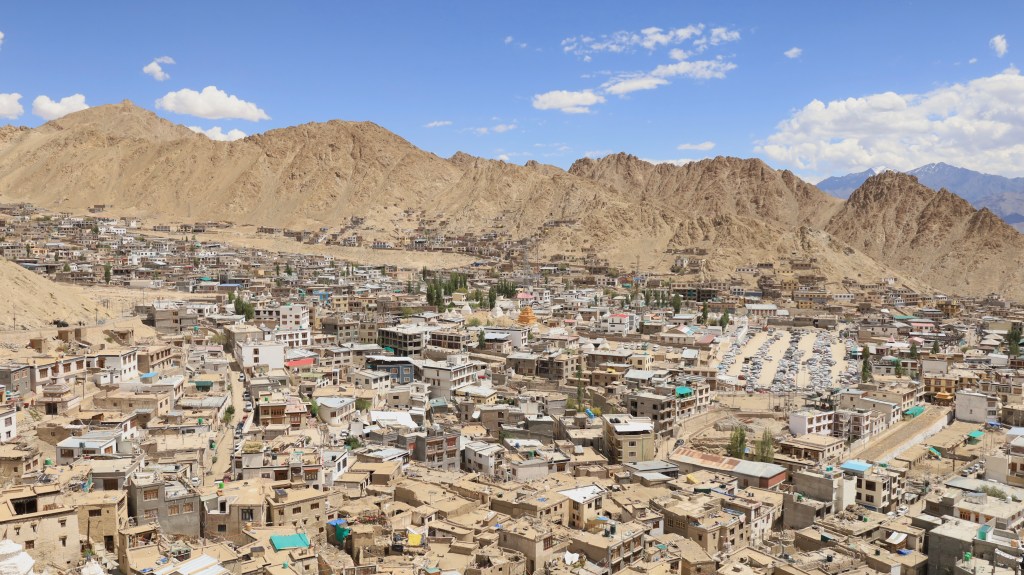
For centuries Leh has been a stop on the trade routes that link India with China and Tibet. It lies in a parched valley along the Indus River, marked by stands of poplar and willow trees that are conspicuously absent from the natural landscape.

The architecture is distinctively Tibetan. Stone buildings are spackled and white washed, with intricately carved doors hung at the entries. Roofs are flat and the windows are accented with ornate woodwork and squares of black paint.

The Ladakhi sky is enormous and the sun is unrelenting. Its glare is amplified by the white washed buildings and treeless mountains that ring the city. In the center of town is the Main Market, a broad pedestrian mall ringed by cafes, hotels, and lots of shops.
The economic engine of Leh is tourism and the season is short. Leh is the jump-off point to the untamed country that surrounds it. Sturdy Royal Enfield motorcycles are available for rental or purchase. Outfitters sell survival gear to the intrepid who strike out on their own, and tour operators offer itineraries for those who’d rather follow.

Buddhism is also big business here. Tibetan markets, sell all the accoutrements of the faith: prayer wheels and singing bowls, incense and butter lamps, thangkas and bumpas. Where His Holiness goes, the faithful surely follow and Ladakh is a pilgrimage for many.
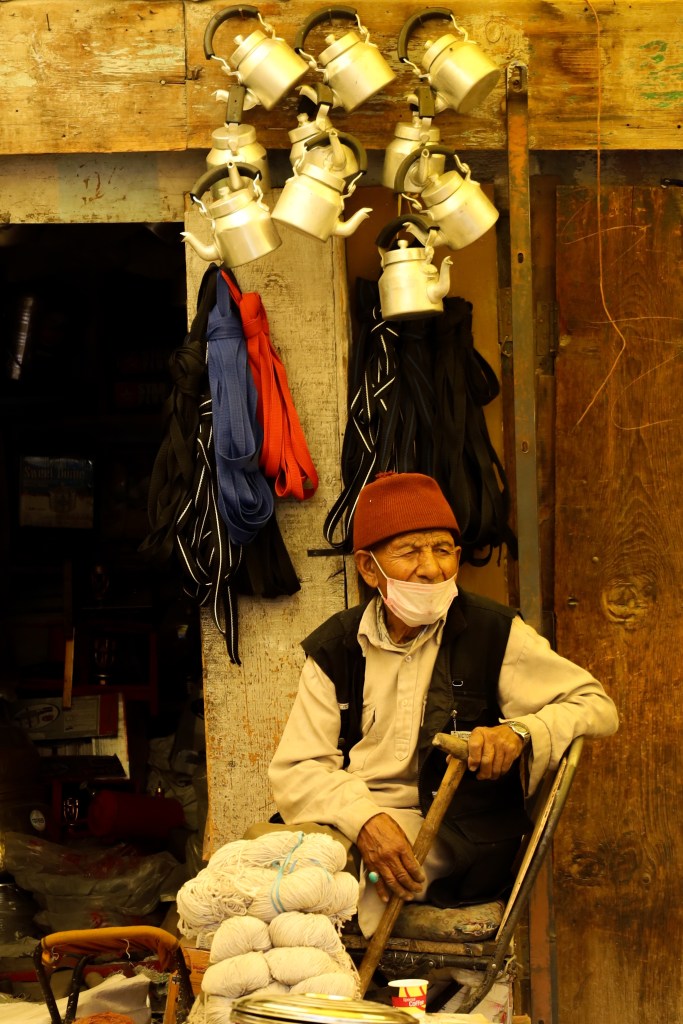
The largest benefactor to the marketplace though, is surely the Kashmiri goat. Most stores specialize in pashminas. A true pashmina is a very sheer garment woven only from the neck hair of a particular goat. It’s quite possibly the softest thing I’ve ever touched – a mere whisper of fabric.
Pashminas can be hand woven or machine made; monochromatic or multicolored; richly embroidered or unadorned. All, though, are impossibly soft.

There are lots of imposters: certificates of authenticity that are anything but authentic and blended fabrics that feel pretty close. Shopkeepers spin a good yarn and it’s easy to get taken.
Price is the best indicator. Real pashminas start high and go higher. While not cheap by Indian standards, they’re more affordable here by orders of magnitude.

I make friends in the shops and learn some tricks to help determine authenticity. Pashmina or not, all of the fabric is high quality. There are colorful saris and shawls, and mittens and scarves, woven from yak wool, more suited to a Himalayan winter.
Should I ever decide to go into the import business, I have some eager partners in my new friends.

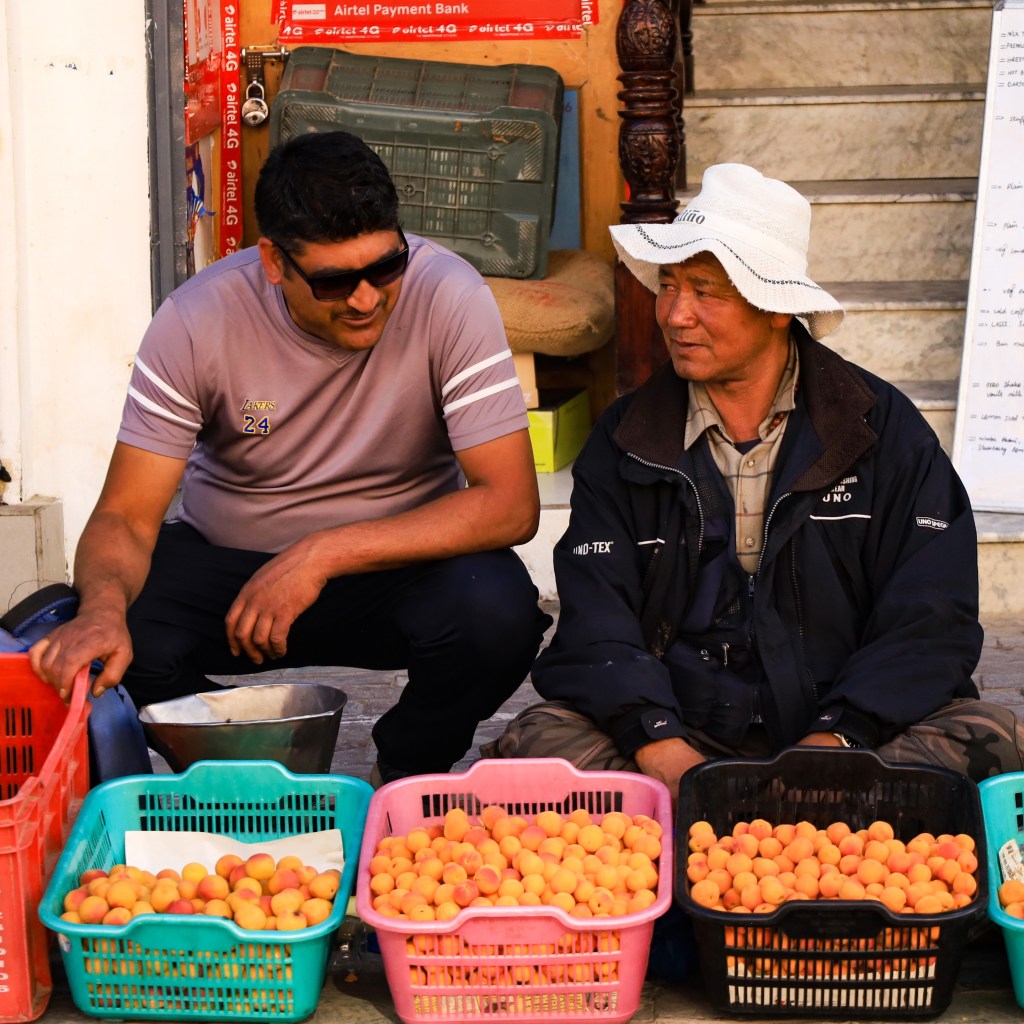
When the sun ebbs in the afternoon, the locals spread produce onto the shaded sidewalks of the Main Market. It’s as much a social gathering as a business venture; as much gossip and laughter is traded here as rupee notes.
It’s a short growing season, and by late July, the apples are already ripe. The golden apricots are showstopper though – sugary and juicy and firm.
I buy them by the kilo.
The Old Town is a collection of ancient houses and meandering alleyways just east of the market. The buildings, once part of a walled complex, are built on a gradient. The homes of the most important families are closest to the palace.

Leh Palace is an imposing fortress with nine story walls and a rooftop that stair-steps the mountainside. For two and a half centuries, it housed the royal family until it was sacked by invaders. The interior walls still have the original Tibetan murals, painted with bright pigments made from powdered gemstones.
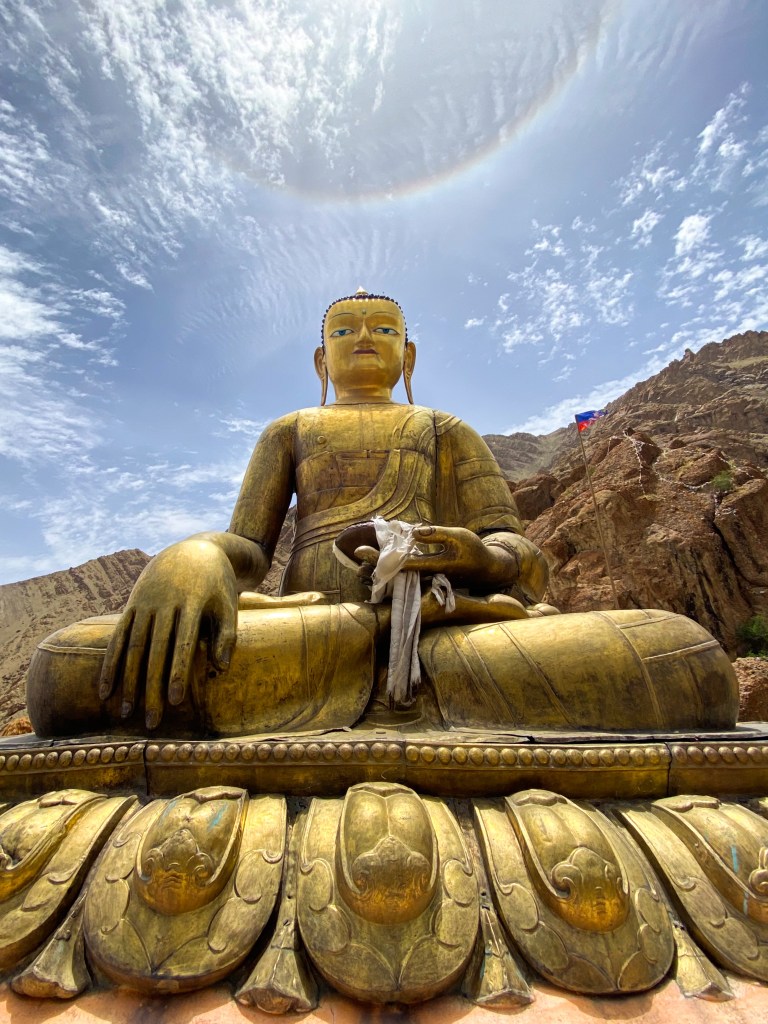
Namgyl Tsemo Monastery sits on the highest peak. Older than the palace, it holds a 3-story tall golden Buddha. Its high chalky walls deflect the sun and there’s a steady breeze in its shaded alcoves.

Ancient architects, across this part of the world, had incredible skill. Buildings were placed with great care. The directionality of walls and the positioning of windows, doors, and hallways, is all designed to corral the breeze. Centuries before the electric fan, they harnessed the wind
We gather in the dim light of the gompa and the cool afforded by its thick walls. Rinpoche plays a Tibetan drum and a set of cymbals left by the altar. And after a soft, lyrical chant to Manjusri, the bodhisattva of wisdom, we sit together in delicious silence.
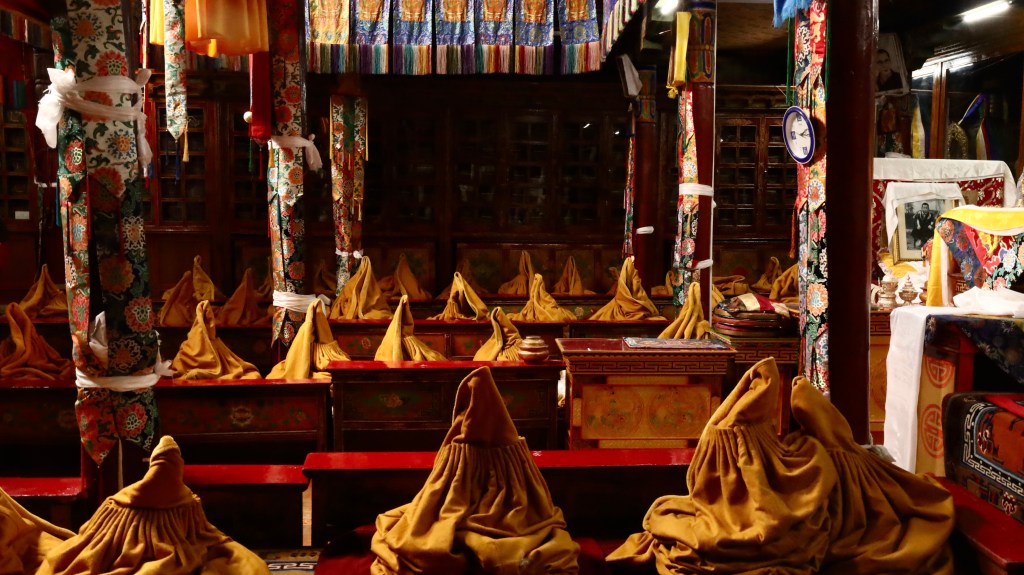
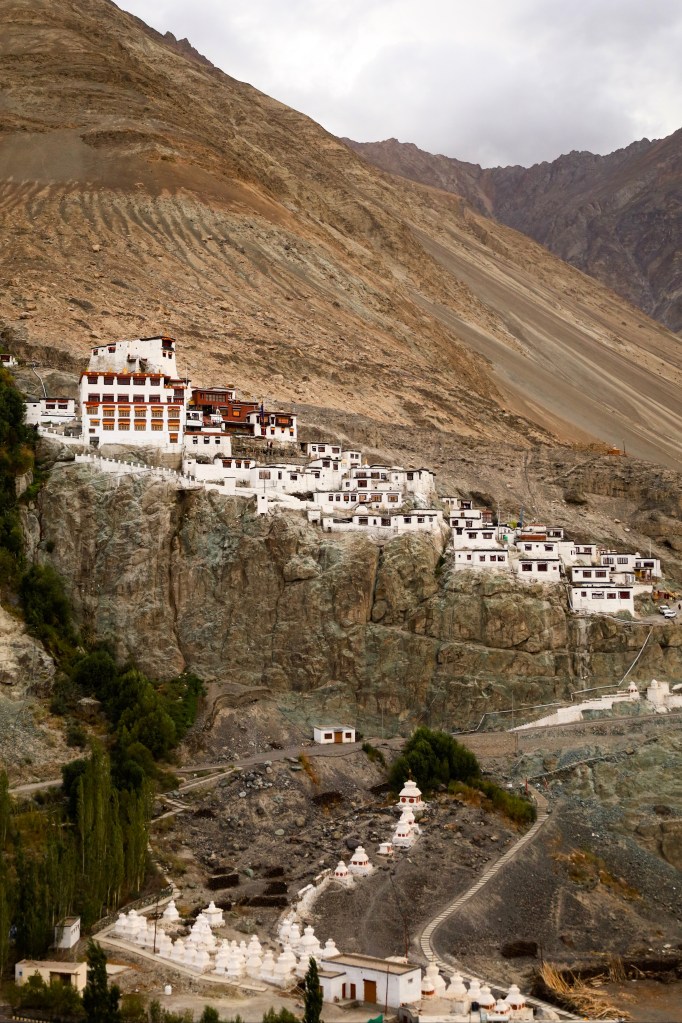
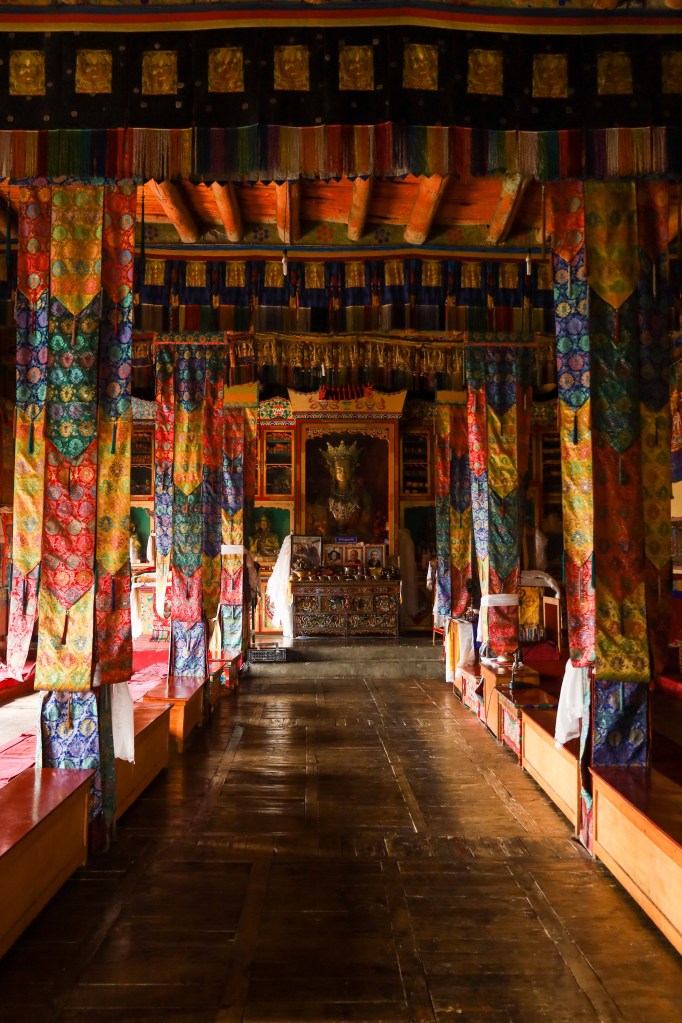
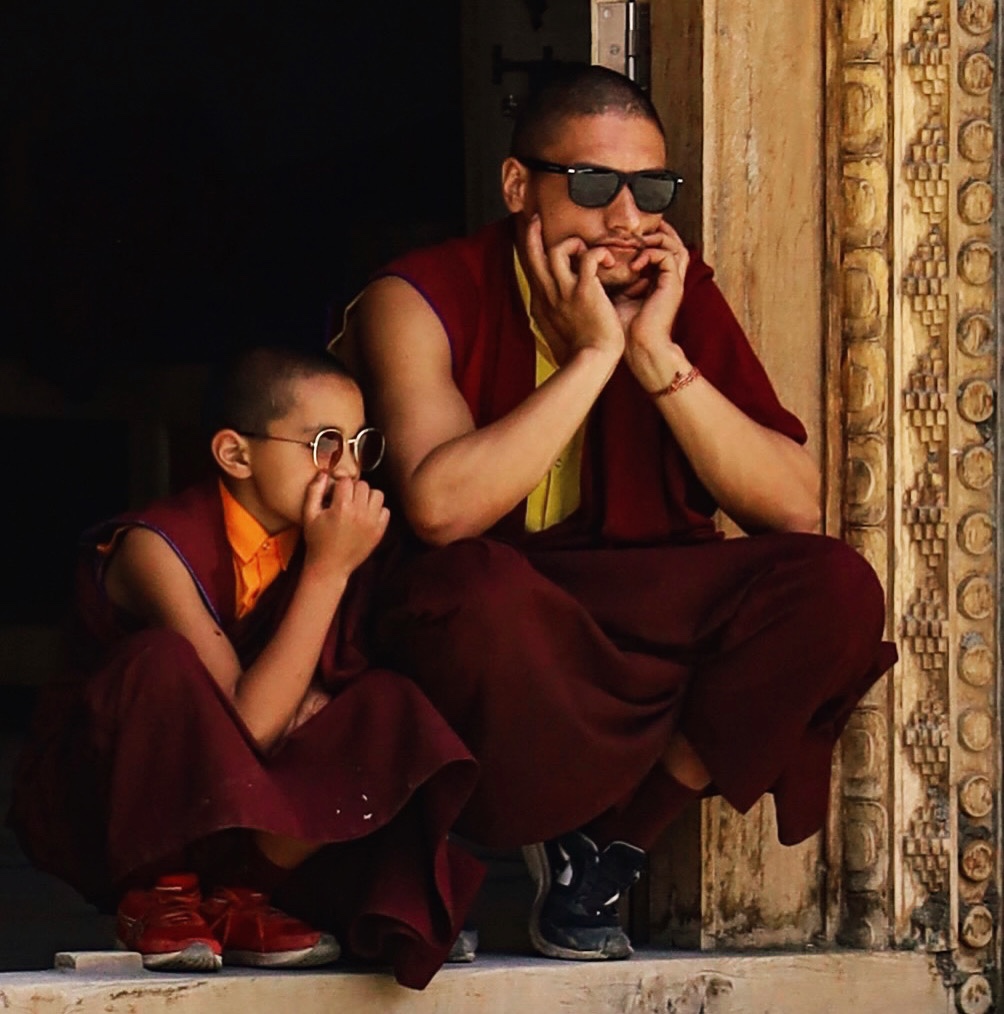
This scene is repeated across Ladakh. In Leh, we rustle up taxis for day trips to the surrounding monasteries. When we venture further away, our stops always coincide with the appearance of a gompa on a hilltop.
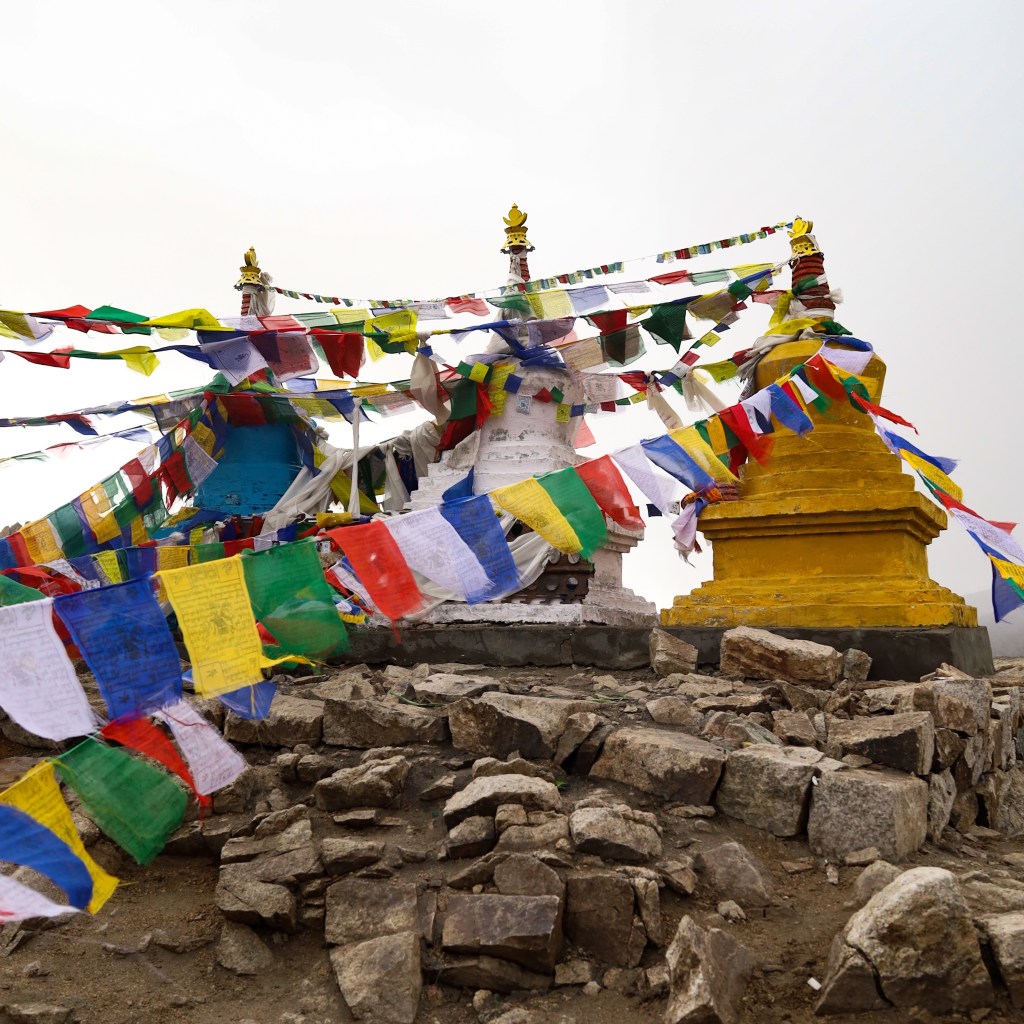
They’re sacred, timeless places, with an indelible mark left by an eon of devotion.

Pangong Lake
With a little time before the Dalai Lama’s teachings, we rent a Tempo and set out to explore.
Getting to Pangong Lake involves another gravelly, mountain-edge road over the Changla Pass – my highest altitude to date. It’s cold and blustery up top. I sip chai under a knit cap, more than a little woozy from the lack of oxygen. After a few days, I still haven’t acclimated to the altitude. I’m a little disappointed at this chink in my armor.
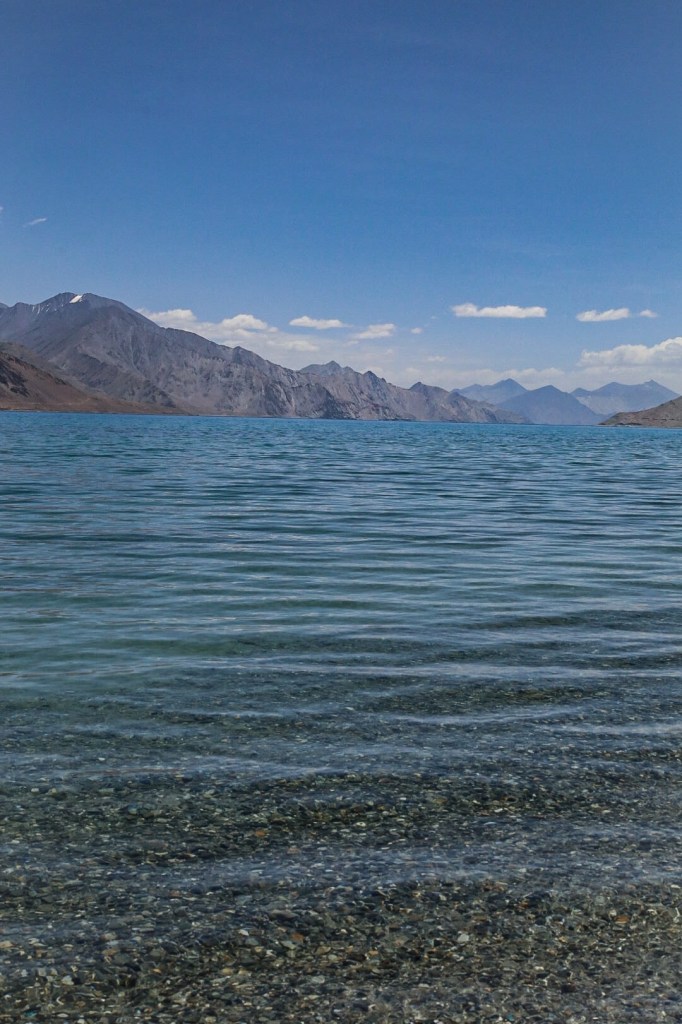
Pangong Lake is the world’s highest saltwater lake at 14,000 feet. The water is smooth as a pane of glass and impossibly blue. It spans 435 square miles between India and Chinese-occupied Tibet, in a disputed and heavily militarized border region.

With strained relations and troops amassed on both sides, tensions sometimes overflow into skirmishes. Rules of engagement bar the use of traditional arms, so the soldiers still face off using makeshift weapons and hand to hand combat.
One incident in 2020 devolved into kicking and rock throwing between the two nuclear-armed superpowers with several hundred casualties on both sides. It’s sort of like the release valve on a very volatile pressure cooker.

A few take the plunge, but the water is very cold and I’m very happy with my very dry clothes. Though salty to the taste, the entire surface freezes over in winter. Seasonal campsites dot the shoreline, but there’s not much permanent infrastructure. It’s a testament to the severity of the winters.

Over lunch, the drivers are concerned that we are too late for a low water crossing. They’re best crossed early, before the sun works against the snowcaps and water levels rise.
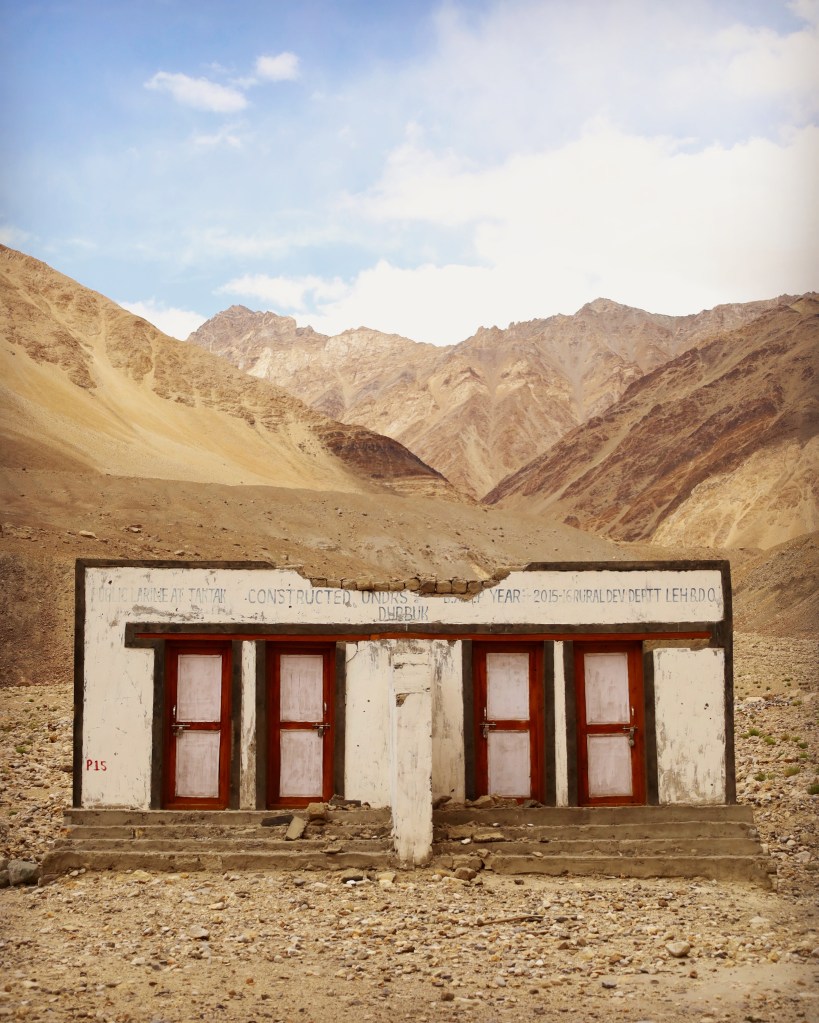
We stop instead in the tiny mountain village of Shyok, where we find a brand new guesthouse that can accommodate all of us. This kind of thing happens when traveling with Rinpoche. As I’d been told it would.
Everything just sort of manifests – effortlessly – exactly as it’s needed. And not just once or twice. There are these supernatural powers, called siddhis, that are manifest in people who’ve reached high levels of attainment. They are by no means the goal, but a sort of byproduct, of years of deep meditative practice and insight into the true nature of reality.
Rinpoche tips his hand a few times in my presence, leaving me with no doubt that he has such gifts. His only acknowledgment is a quick glance and the grin of a mischievous child.
In Shyok, we meet the head monk who is from another sect. His robes aren’t that different, but he wears a beard and matted dreadlocks. Tibetan Buddhism is actually quite wide ranging. Schools may be separated by a differing view on some obscure point of logic, but it’s a still big family with the Dalai Lame at the head of the table.
The monk opens the village gompa and invites us to see the “self-emanating statues” in a neighboring valley the next morning.
The valley turns out to be in a restricted area, blocked off by a military installation. Somehow, the two monks in the head taxi persuade the Indian military to let 15 foreigners drive a van across their base and enter a no-go zone to look for deities that appear magically on the cliffs. And they don’t even check our papers.
Only in India.

Once inside, we’re alone in this cathedral of a valley as first light creeps over the edge. It’s simply breathtaking.
The self-emanating statues take a leap of faith that I can’t quite muster. The sacred images on the rocks are hardly definitive. It’s like looking for animal shapes in the clouds or the woman who sees Jesus on her breakfast toast – more imagination than reality.
Miraculous statues or not, the valley is worth the drive.

The Nubra Valley

The low water crossing isn’t far beyond the village. If morning crossings are best, I’d hate to see afternoon. It’s early yet, and a broad, fast moving stream already covers the roadway.
One car is stuck when we arrive and others quickly follow. One by one, vehicles takes their turn as a growing number look on. The crowd lets out a cheer every time one clears the water and a collective sigh when they don’t. About half get hung up midway through and need a push from one of Tempos.
Tempos aren’t built like passenger vans in the west. They sit higher, have 4-wheel-drive, and lots of power. When it’s our turn, our driver stomps the gas. Spitting gravel, we tear into the water. The engine screams as all four wheels clamor for traction, and after a moment of tense silence, we claw up the other side. Even loaded with a dozen passengers and all of our gear, the Tempo doesn’t hesitate.

We motor along the Shyok river, north to where it meets the Nubra. The landscape is astounding the entire way. We break for lunch in Sumur, where the Nubra Valley is so wide and flat it feels more like plain than a valley.
On our way to Hunder, a gathering thunderstorm pushes down the valley from the north. As the winds pick up though, I can tell by the orange glow that there’ll be no rain. This is my second sandstorm in as many months, and it’s quite a trip.

Soon, everything that can be lifted is airborne as giant plumes of dust waft in and block out the afternoon light. I close my eyes against torrents of grit and sand that stings my skin. It’s all over in a matter of minutes, but it’s very intense. And when it calms, everything is caked in a layer of fine dust.

Hunder is a rare oasis of green and it seems that every tourist in Ladakh has made their way here. Packs of motorbikes prowl the roads and the Tempos stop at any vista worthy of a selfie.
Hunder is famous for its sand dunes. People come to the ride camels, go four-wheeling, and take pictures dressed in traditional Ladakhi clothes. It’s certainly not an authentic experience but the atmosphere is festive.
Nearby, Diskit Monastery sits over the valley with a 106-foot tall statue of Maitreya Buddha just below. It’s perhaps my favorite monastery. It’s not the most impressive nor the oldest monastery we visit, but I have a sense of total peace and clarity in its walls.
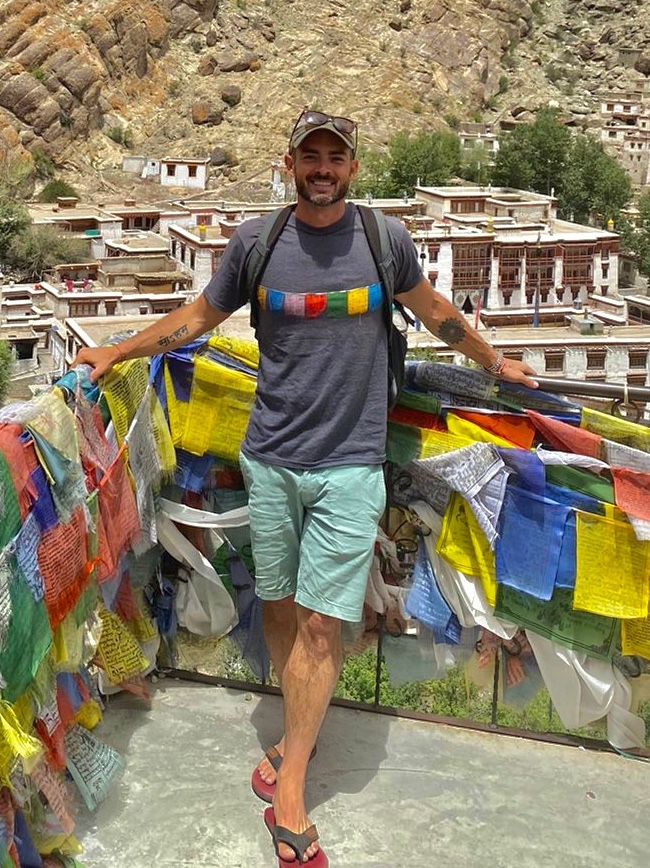
Khardungla Pass is our final summit of the trip. At 18,739 feet, it’s the highest motorable pass in the world. We stop at the top for chai, while I dodge snowflakes wearing shorts and flip slops and shorts in air so thin I feel a bit drunk.

The daunting task of constructing and maintaining the roads in Ladakh goes to the Border Road Organization, or BRO. They patch potholes, build bridges, and install some of the finest signage on the planet.

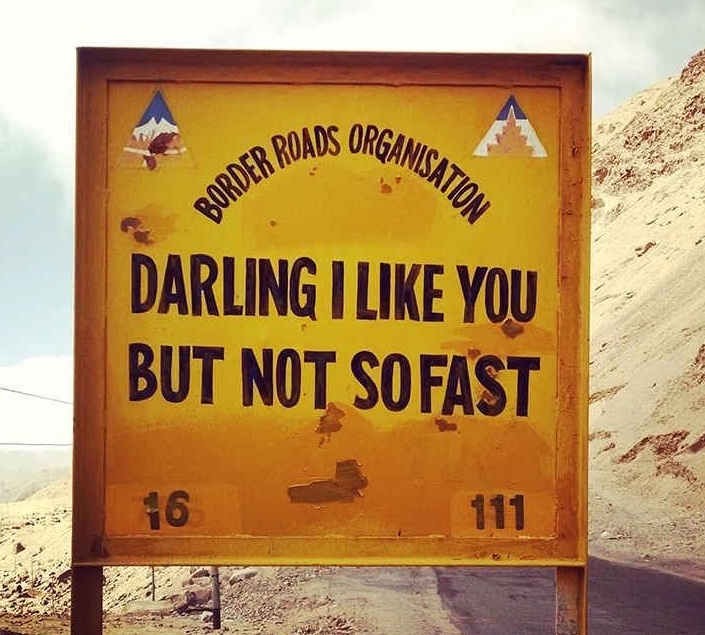

They urge caution to drivers with a mix of pun, rhyme, and innuendo worthy of the worst “dad joke”. The result is a terribly wonderful and collecting them became something of a travel game.

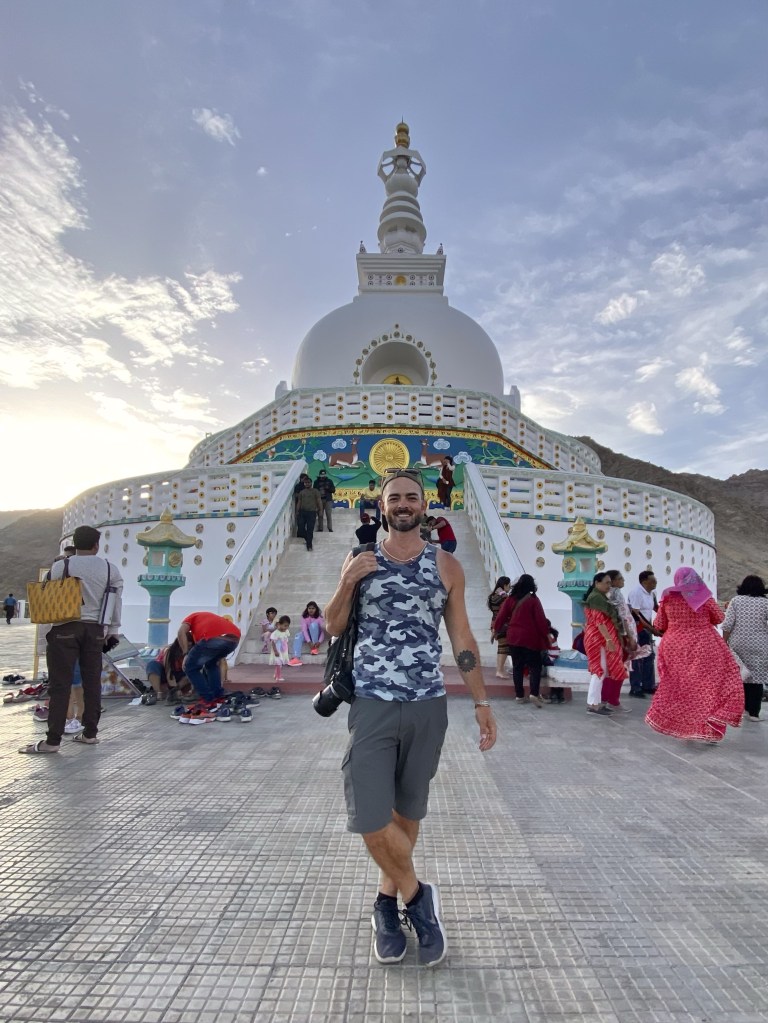
Back in Leh, we gather around a long dining table for group breakfasts and after dinner chai. I catch sunsets at the Shanti Stupa, overlooking the entire city, and learn that it does, in fact, rain in Ladakh – sometimes quite a bit.

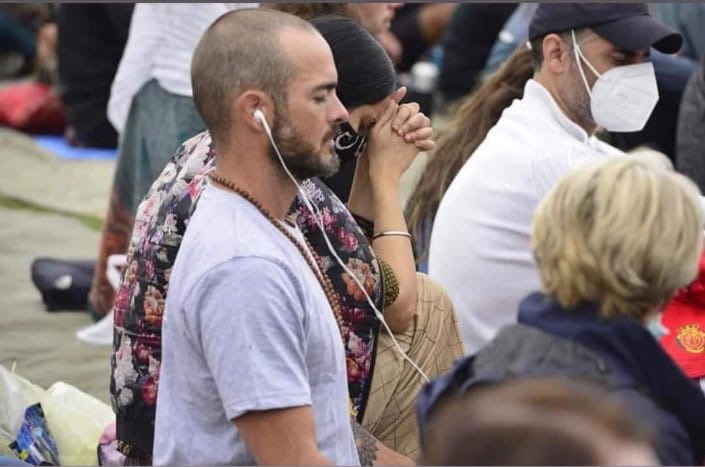
We brave miles of traffic at daybreak to attend teachings with the Dalai Lama at a fairground south of town. His theme is always one of loving compassion, and just being in his presence is profound.
“Dana” is the Buddhist concept of generosity; of giving without expecting anything in return. I’m lucky enough to experience it firsthand with the sangha.
Several people always start their day in the kitchen, while others make a run to the market for fresh baked goods. One friend coordinates all of our travel details and another translates for Rinpoche during class. When we dine out together, the bill is often as not paid before the check arrives – anonymously.
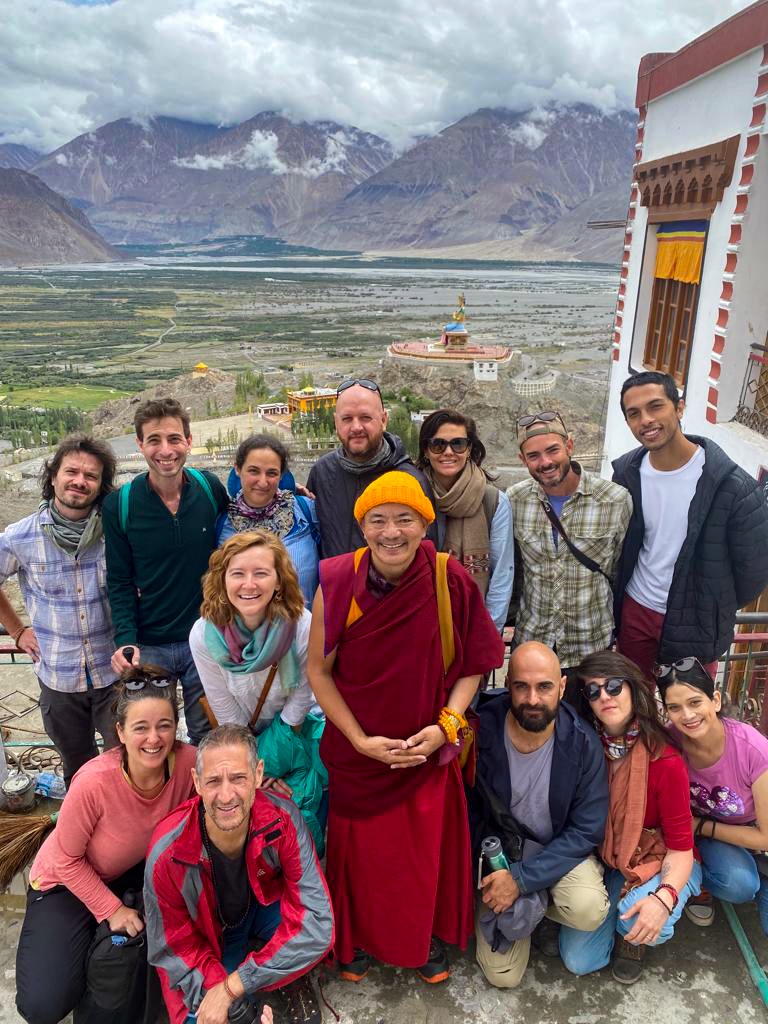
It is indeed a rare opportunity to meet such a group of people, much less be welcomed as one of them. Most of the sangha will return to Dharamshala to continue their studies in the rain, others will head back to their home countries in the west, and I will continue on to the greener pastures of Kashmir.
Should I remember one word from Ladakh, it will be certainly be “julley”. Pronounced “joo-lay”, it’s the Ladakhi ‘aloha’: used for hello and goodbye, please and thank you, or pretty much anything good in Ladakh. It’s volleyed on the streets and peppered into nearly every interaction – always with a smile.

Ladakh is a land of extremes: of short, dry summers and long, snowy winters; of bleak, barren landscapes and warm, welcoming people. It’s the monsoon home of the pacifist Dalai Lama and also ground zero for a conflict between the two largest nations on earth.
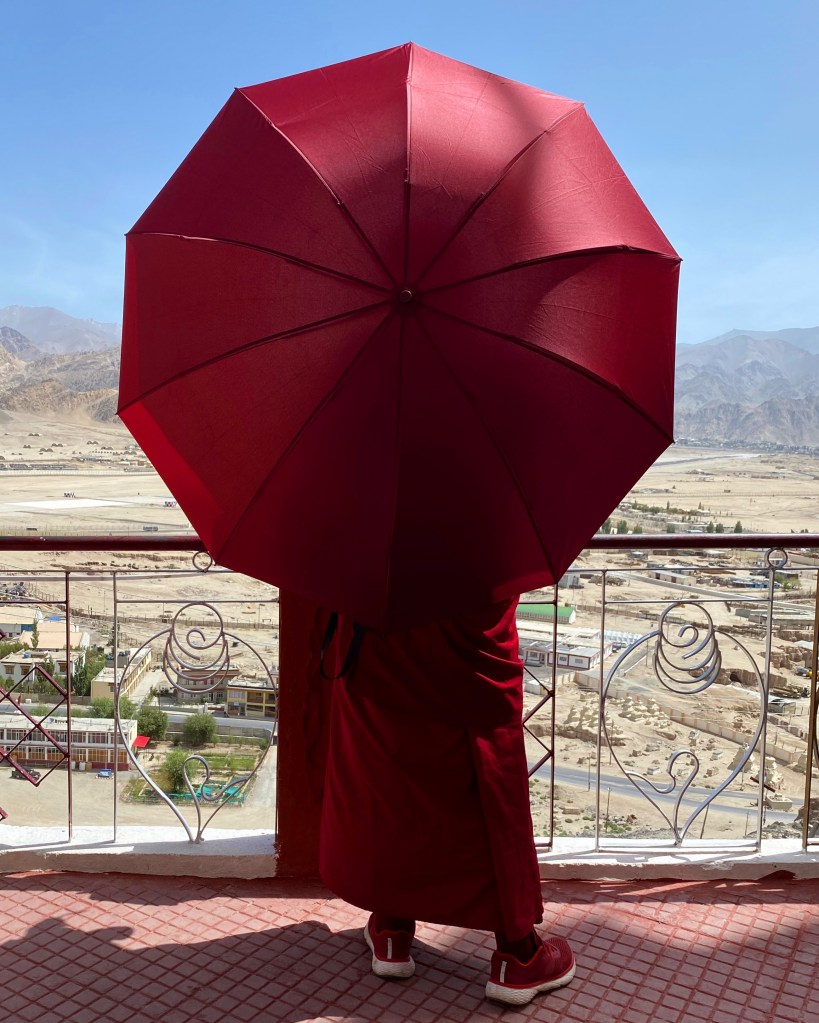
Called it the Land of High Passes, Little Tibet, or Broken Moon Land, there’s nothing quite like it. I’m fortunate to have had the chance to see it; to travel across its rocky moonscapes and sit in its sacred places. I’m more fortunate still, to have experienced it all with this special sangha and the exuberant Tibetan lama we call Rinpoche.
Julley, Ladakh. Julley.
 Christopher’s Travels
Julley. Fantastic blog. The only thing better than the beautiful photographs were the accompanying narratives. You have certainly managed to give your readers/followers a true insight into this unique part of God’s world…